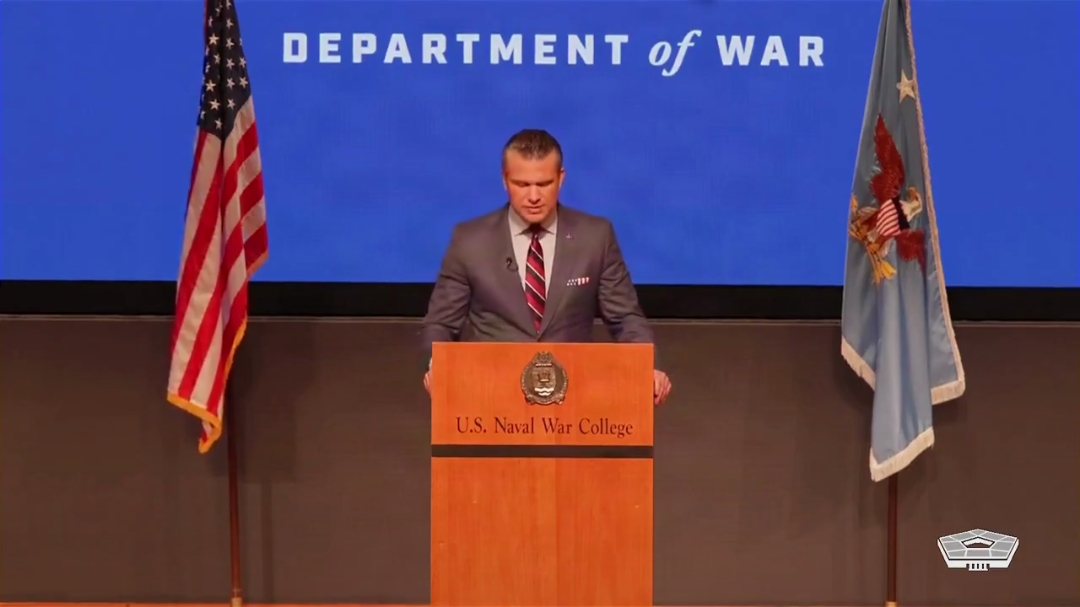
The United States is undergoing one of the most significant changes in its national security strategy since the end of the Second World War, according to a statement shared by the US Department of War.
The statement describes the shift as more profound than the collapse of the Soviet Union. It says President Donald Trump’s America First foreign policy and the 2026 National Defense Strategy have overturned assumptions that guided American foreign policy for nearly eight decades.
The statement was published by the US Department of War’s official account on X.
It reads:
“The United States is currently in the midst of the most far-reaching strategic recalibration of our national security posture since the end of the Second World War.
The pivot is deeper and more profound than the fall of the Soviet Union.”
The declaration signals a major change in how Washington intends to protect its interests, manage military commitments and work with international partners.
What has changed in America’s national security strategy?
The foundation of this shift is the 2026 National Defense Strategy (NDS), released on January 23, 2026.
The document establishes four major priorities for the US military:
- Defend the American homeland.
- Deter China in the Indo-Pacific through military strength.
- Increase the defence responsibilities of US allies and partners.
- Strengthen America’s domestic defence industrial base.
These priorities place direct emphasis on protecting American territory, securing strategic interests and reducing the country’s dependence on military commitments abroad.
The full strategy is available in the official 2026 National Defense Strategy document.
America wants allies to take greater responsibility
One of the most important changes concerns America’s traditional security partnerships.
For decades, Washington played a central role in providing military protection to allies across Europe, the Middle East and Asia.
The new strategy calls for these partners to assume primary responsibility for their own regional defence, while the United States provides more limited but strategically important support.
In Europe, the document expects NATO allies to take the lead in conventional defence against regional threats.
It also calls for partners in the Middle East and on the Korean Peninsula to assume greater responsibility for their own security.
This does not mean the United States is ending its alliances. Instead, Washington is changing the conditions under which it expects to provide military support.
The strategy makes clear that defence cooperation, arms sales and other forms of assistance will increasingly depend on how much allies contribute to shared security.
China and the Indo-Pacific remain major priorities
Although the strategy gives greater attention to American homeland defence, it does not remove China from Washington’s strategic calculations.
The second major priority is deterring China in the Indo-Pacific.
The document calls for maintaining a favourable balance of military power in the region. It also emphasises cooperation with regional partners and stronger military capabilities.
This indicates that the United States intends to remain engaged in the Indo-Pacific while expecting its allies to contribute more to regional security.
The approach reflects Washington’s attempt to concentrate military resources on what it considers its most important strategic interests.
Europe faces a different American security commitment
The strategy has important implications for European governments.
For many years, European security planning relied heavily on American military capabilities and Washington’s commitment to NATO.
The 2026 strategy changes that expectation by calling on European allies to take primary responsibility for their conventional defence.
A European Parliament research briefing published on April 20, 2026 describes this as a major reorientation of American defence policy.
The briefing notes that the new approach could encourage Europe to strengthen its own military capabilities. However, it also raises concerns about uncertainty surrounding future American support and the practical implementation of the strategy.
For European governments, the challenge is to increase their defence capabilities while maintaining the existing transatlantic security relationship.
What does this mean for the Middle East?
The strategy also changes how Washington approaches security responsibilities in the Middle East.
It calls on regional partners to take greater responsibility for their own defence, with the United States retaining the ability to provide critical support and conduct focused military operations.
Iran remains an important security concern in the document.
The strategy also identifies the importance of protecting American interests and maintaining regional deterrence.
For countries across the Gulf and wider Middle East, this approach could increase pressure to develop their own military capabilities and regional security arrangements.
However, the document does not indicate that Washington intends to abandon the region entirely.
A major departure, but not a complete withdrawal
The language used in the Department of War’s statement is particularly significant.
It describes the current strategic shift as deeper than the geopolitical transformation that followed the collapse of the Soviet Union.
That is a powerful historical comparison. However, it is the administration’s characterisation of its own policy, not an independently established historical measurement.
The Center for Strategic and International Studies (CSIS) has identified substantial changes in the strategy, particularly its emphasis on homeland security, allied burden-sharing and the defence industrial base.
At the same time, the strategy retains important elements of America’s global military engagement, including deterrence against China and cooperation with international partners.
The Council on Foreign Relations has also highlighted the administration’s effort to redirect military resources towards homeland defence and the Western Hemisphere while asking allies to shoulder more responsibility elsewhere.
The bigger geopolitical question
For nearly eight decades after the Second World War, American military power and security commitments played a central role in shaping the international order.
The 2026 National Defense Strategy signals a different approach.
Washington wants to prioritise its homeland, protect strategic interests, deter China and demand greater contributions from its allies.
The key question is how this shift will affect countries that have depended on American military support for generations.
Will greater allied responsibility create a more balanced international security system, or will it produce uncertainty as traditional American commitments change?
The consequences will depend on how the strategy is implemented and how America’s allies respond.
Standing with the oppressed. Speaking for the unheard. Seeking truth without fear.