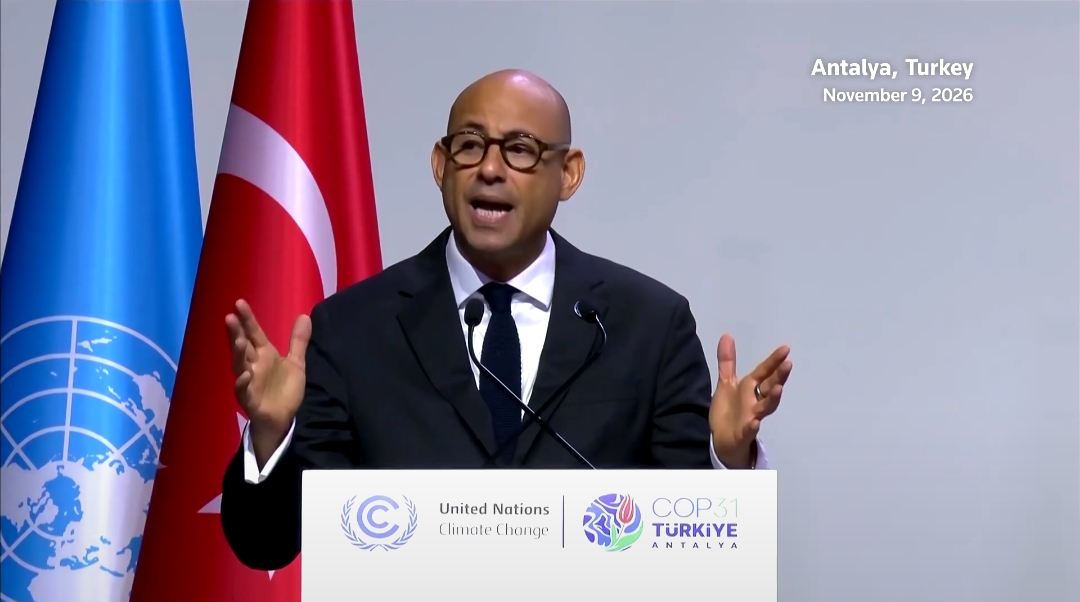
The United Nations has called on governments to accelerate action against global warming as COP31 opened in Antalya, Türkiye, on November 9, 2026.
Simon Stiell, Executive Secretary of the United Nations Framework Convention on Climate Change (UNFCCC), warned that international climate conferences alone cannot solve the climate crisis. He urged governments to turn scientific warnings and existing climate commitments into practical action.
Speaking at the opening of COP31, Stiell said:
“No COP is a silver bullet. No single conference can bridge the chasm between the science and reality.”
His remarks underline a growing concern within the international climate process: governments have made numerous promises, but action on the ground remains too slow.
The statement was also highlighted by Reuters in a video shared on X.
COP31 opens with calls for faster climate action
COP31 brings together governments, climate experts and international organisations to discuss the global response to climate change.
The conference opened in Antalya against a backdrop of rising temperatures, extreme weather events and growing economic pressure.
Stiell said the urgency of the climate crisis must push countries to move beyond political declarations.
He argued that COP31 should focus on delivering practical solutions and implementing commitments made at previous climate conferences.
According to the official UN Climate Change opening statement, the priorities include expanding renewable energy, improving access to climate finance and reducing methane emissions.
Climate science and government action remain far apart
Stiell’s warning points to a major challenge in international climate policy.
Scientists have repeatedly warned that rising greenhouse gas emissions are increasing global temperatures and intensifying climate risks.
However, national policies and financial commitments have not yet delivered reductions at the speed required.
A United Nations Environment Programme report published in October 2026 warned that the world remains on course to exceed the Paris Agreement’s 1.5°C warming threshold.
Reuters reported that the UN assessment called for steep emissions cuts to limit further warming.
The findings highlight the distance between the climate targets agreed by governments and the measures currently being implemented.
Renewable energy and methane reduction among key priorities
Stiell called for countries to accelerate the transition towards renewable energy.
He highlighted the need to expand global renewable energy capacity, strengthen electricity grids and make clean energy available across national borders.
He also urged governments to reduce methane emissions, particularly from the oil and gas industries and waste sectors.
Methane is a powerful greenhouse gas. Cutting its emissions can help slow the rate of global warming.
The UN climate chief also highlighted the economic benefits of renewable energy.
In his opening statement, he said global renewable energy had saved around $500 billion in fossil fuel costs during 2025. He added that another $265 billion had been saved during the first half of 2026.
These figures underline the economic argument for expanding clean energy alongside its environmental benefits.
Climate finance remains a major challenge for developing countries
Another important issue at COP31 is access to climate finance.
Developing countries face growing costs from floods, droughts, extreme heat and other climate-related disasters. Many also need substantial investment to strengthen infrastructure and shift towards cleaner energy.
However, access to international climate funding remains difficult for many countries.
Stiell called for solutions that would help developing nations access funds already committed by governments.
He also highlighted the need to advance existing international financial commitments.
These include the goal of providing $300 billion annually in climate finance by 2035 and scaling up wider climate finance flows towards $1.3 trillion annually by the same year.
The UN climate chief stressed that countries must focus on delivering these commitments rather than reopening agreements already reached.
Himalayas face growing climate risks
Stiell also referred to the devastating consequences of climate-related disasters in the Himalayan region.
He warned that vulnerable communities are paying a particularly high price as global temperatures rise.
His remarks come amid reports of extreme weather and a deadly glacier-related disaster in Nepal.
According to Reuters’ COP31 coverage, a glacier collapse in Nepal triggered flooding that killed more than 1,450 people, while thousands more remained missing.
The disaster highlights the risks facing mountain communities and regions dependent on fragile water systems.
For countries such as India, Nepal and other Himalayan nations, climate resilience, disaster preparedness and protection of vulnerable communities remain critical priorities.
Fossil fuel dependence creates economic pressure
The climate debate at COP31 is also connected to global energy security.
Stiell warned that recent volatility in fossil fuel prices had placed additional pressure on households and economies.
Wars and disruptions to energy supplies have exposed the economic risks of continued dependence on coal, oil and gas.
At the same time, some countries have increased their reliance on coal to meet energy needs.
This creates a difficult challenge for governments. They must maintain reliable and affordable energy supplies while reducing emissions.
The UN climate chief has argued that expanding renewable energy can help address both challenges.
The United States stays away from COP31
Another significant development is the absence of the United States government from this year’s climate negotiations.
Reuters reported that the Trump administration is staying away from COP31 for the second consecutive year.
The absence of one of the world’s major economies and greenhouse gas emitters adds another challenge to international climate cooperation.
Meanwhile, governments attending the summit face pressure to strengthen their commitments and deliver measurable progress.
The real test is what happens after COP31
Stiell’s message is clear: climate conferences must produce more than declarations and political promises.
Countries need to accelerate emissions reductions, expand renewable energy, improve access to climate finance and protect communities facing the effects of global warming.
The success of COP31 will therefore depend not only on what governments announce in Antalya, but also on whether those commitments lead to measurable changes after the conference.
As Stiell warned, no single summit can bridge the gap between climate science and reality.
The responsibility now rests with governments to turn international commitments into action.
Standing with the oppressed. Speaking for the unheard. Seeking truth without fear.