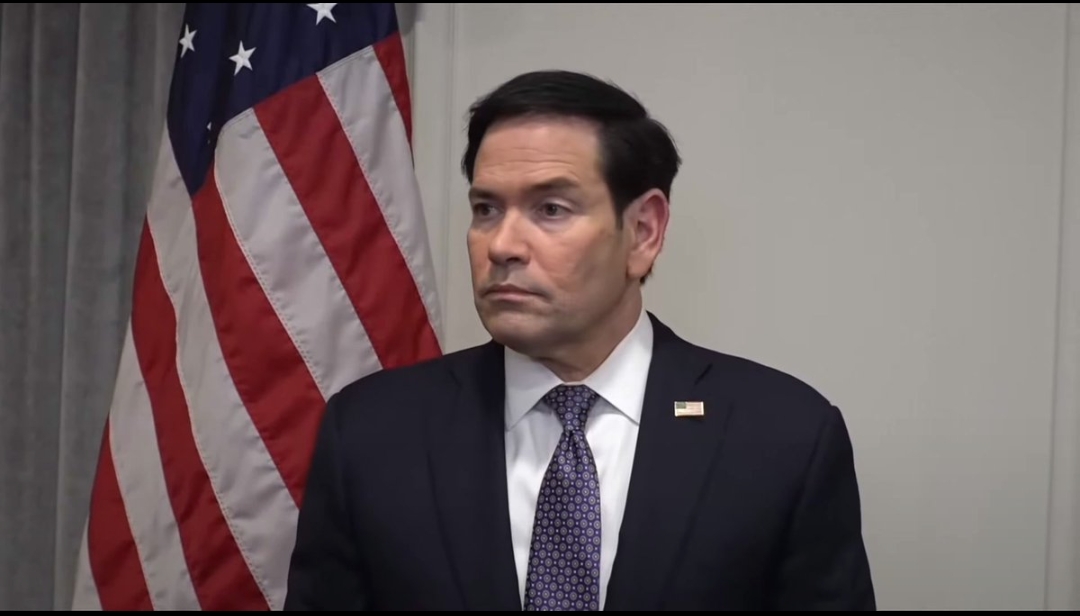
The US Secretary of State says Washington could inflict serious damage on the International Criminal Court over its jurisdiction. But his defence of Netanyahu raises a wider question: why does the United States demand international accountability over Iran’s nuclear programme while opposing an international court’s scrutiny of Israeli leaders?
US Secretary of State Marco Rubio has renewed Washington’s criticism of the International Criminal Court (ICC), arguing that the court should not exercise jurisdiction over citizens of countries that have not joined the Rome Statute.
Speaking to reporters, Rubio said:
“Today it’s Netanyahu, tomorrow it will be an American. It’s not about the individuals, it’s about the ICC.”
His remarks came during discussions about the ICC’s arrest warrants for Israeli Prime Minister Benjamin Netanyahu and former Defence Minister Yoav Gallant.
Rubio argued that the issue was not about protecting particular individuals but about the court claiming authority over nationals of countries that are not members of the treaty establishing it.
However, the statement raises an important question about the United States’ position on international accountability: Does Washington support international scrutiny when it concerns countries such as Iran, but oppose it when the scrutiny reaches its allies or its own officials?
1. Why did the ICC issue arrest warrants for Netanyahu and Gallant?
On 21 November 2024, the International Criminal Court issued arrest warrants for Netanyahu and Gallant in connection with alleged crimes committed during Israel’s military campaign in Gaza.
The ICC Pre-Trial Chamber said there were reasonable grounds to believe that both men bore criminal responsibility for:
- The war crime of starvation as a method of warfare.
- The crimes against humanity of murder, persecution and other inhumane acts.
- The war crime of intentionally directing attacks against the civilian population, in their capacity as civilian superiors.
The court’s findings concerned the period from at least 8 October 2023 to 20 May 2024.
The judges also found reasonable grounds to believe that restrictions on essential supplies, including food, water, medicine, fuel and electricity, had deprived Gaza’s civilian population of items necessary for survival.
These are arrest warrants based on the legal threshold of reasonable grounds to believe. They are not final convictions, and Netanyahu and Gallant have not been convicted by the ICC in these cases.
Israel rejected the court’s jurisdiction and challenged its authority. However, the ICC rejected Israel’s challenges at that stage.
2. The United States is not a member of the ICC — but that is not the whole jurisdiction question
Rubio’s central argument is that the United States never joined the Rome Statute and therefore should not be subject to the ICC’s authority.
The United States is indeed not a party to the Rome Statute. Israel is also not a member.
But the legal question is more complicated than simply asking whether the accused person’s country has joined the court.
The Rome Statute allows the ICC to exercise jurisdiction over certain crimes committed on the territory of a state that has accepted the court’s jurisdiction, even when the accused person is a national of a country that has not joined the treaty.
That territorial jurisdiction is central to the Palestine situation.
Palestine became a party to the Rome Statute in 2015. The ICC has held that its jurisdiction in this situation extends to Gaza and the West Bank, including East Jerusalem.
When Israel challenged the court’s jurisdiction, the judges ruled that Israel’s acceptance of the court’s jurisdiction was not required for the ICC to exercise jurisdiction on the basis of Palestinian territory.
Therefore, the argument that Israel is not a member of the ICC does not, by itself, settle the question of whether the court can investigate alleged crimes committed in occupied Palestinian territory.
The United States disagrees with the ICC’s position. But disagreement with a court’s legal interpretation is not the same as proving that the court has no legal basis for its jurisdiction.
3. Washington’s pressure campaign against the ICC
Rubio’s latest comments are part of a wider US campaign against the court.
On 9 October 2026, the Trump administration announced sanctions against the ICC. In its statement, Rubio said the United States would restrict transactions involving the court and seek to damage its ability to operate.
He also warned:
“Either the ICC will end its threats, or we will end the ICC.”
During his latest remarks, Rubio said Washington had tried for around a year and a half to persuade the court to change its approach. He added that the United States believed it could inflict “tremendous damage” on the ICC if it did not change course.
The question is no longer limited to whether Washington agrees with the court’s jurisdiction. It is also about the consequences of a powerful country using economic and political pressure against an international judicial institution.
The United States says it is defending its sovereignty and protecting its citizens. Critics argue that sanctions and threats against the court risk obstructing independent investigations and weakening international justice.
4. Why does the United States defend Israel’s leaders?
The ICC warrants against Netanyahu and Gallant have become a major point of disagreement between Washington and the court.
Rubio says the United States is concerned about a legal precedent that could eventually affect American citizens, including military personnel and political leaders.
However, the wider political context cannot be ignored.
In July 2026, US President Donald Trump publicly said that Rubio’s campaign against the ICC was intended to defend Netanyahu and others, rather than Trump himself. That statement added to questions about the relationship between Washington’s opposition to the court and the arrest warrants against Israeli leaders.
The US government maintains that its objection is about jurisdiction and American sovereignty. But the political consequences of its campaign also benefit Israeli leaders facing ICC arrest warrants.
This creates a legitimate question: if the United States believes the ICC should not exercise jurisdiction over nationals of non-member states, should that position also apply consistently when the accused are from countries that are not American allies?
5. Iran is an NPT member, while Israel remains outside the treaty
The contrast becomes particularly important when Iran’s nuclear programme is considered.
Iran is a party to the Treaty on the Non-Proliferation of Nuclear Weapons (NPT). As a non-nuclear-weapon state party, Iran has obligations under the treaty, including safeguards obligations through the International Atomic Energy Agency (IAEA).
Israel, on the other hand, has not joined the NPT.
Israel is widely believed to possess nuclear weapons, although its official policy has been one of nuclear ambiguity: it neither confirms nor denies possessing them.
The Stockholm International Peace Research Institute (SIPRI) estimates that Israel has approximately 80 nuclear warheads. Such figures are estimates, not an official Israeli declaration.
Israel’s non-membership of the NPT means it is not subject to the same NPT obligations that apply to Iran as a non-nuclear-weapon state party.
However, it would be inaccurate to say that Israel has no nuclear safeguards arrangements whatsoever. The IAEA lists specific safeguards agreements involving Israel, including an agreement concerning certain nuclear material and facilities. These are not equivalent to the comprehensive safeguards agreement that Iran has under the NPT.
This difference matters when comparing the international scrutiny applied to the two countries.
6. Iran faces IAEA scrutiny under its NPT safeguards obligations
Iran’s membership of the NPT brings legally binding safeguards obligations.
The IAEA has raised questions about undeclared nuclear material and activities in Iran and has repeatedly sought explanations from Tehran.
On 12 June 2025, the IAEA Board of Governors adopted a resolution finding Iran in non-compliance with its safeguards agreement. The finding concerned Iran’s failure to cooperate fully with the Agency in resolving outstanding safeguards issues.
The IAEA’s concerns included questions about undeclared nuclear material and activities at locations in Iran. The Agency said it could not provide assurance that Iran’s nuclear programme was exclusively peaceful.
Iran has disputed aspects of the international pressure and accusations surrounding its nuclear programme. Nevertheless, the IAEA safeguards findings are a formal part of the international record and should not be ignored.
The important distinction is that Iran is being scrutinised under its NPT-related safeguards obligations, while Israel has not joined the NPT and therefore does not carry the same treaty obligations.
7. The question of equal standards and international accountability
The United States argues that the ICC should not claim authority over American citizens because Washington never joined the Rome Statute.
But the United States also expects international institutions to scrutinise Iran’s nuclear activities and hold Tehran accountable for its obligations under the NPT and its safeguards agreement.
These are different legal frameworks. The ICC deals with individual criminal responsibility for crimes such as war crimes and crimes against humanity. The NPT and IAEA safeguards system deal with nuclear non-proliferation and the verification of nuclear material and activities.
They cannot simply be treated as identical legal cases.
Nevertheless, the political question of consistency remains.
If a country demands international scrutiny of another state, but uses its political and economic power to weaken an international court when that court investigates an ally, it risks creating the perception that international accountability depends on political relationships.
International law is supposed to apply through legal rules and evidence, not through the identity or political influence of the accused.
Editor’s View
The most serious danger is not limited to the case involving Netanyahu or any particular American official. It concerns the future credibility of international justice.
If a powerful country can threaten an international court whenever its allies or officials face investigation, other powerful countries may follow the same approach.
Tomorrow, another government could defend a leader accused of war crimes, crimes against humanity or attacks on civilians by threatening sanctions against the court, pressuring its members or attempting to undermine its authority.
If that becomes an accepted practice, what protection will remain for civilians who have suffered during wars and military operations?
The world cannot build a credible system of justice in which powerful countries demand accountability from their rivals but reject scrutiny when their own allies face allegations.
International justice must not become a system in which the powerful decide who can be investigated and who must remain beyond accountability. The law should apply equally, regardless of a country’s military strength, political influence or alliances.
Sources
- Marco Rubio’s remarks — Clash Report on X
- International Criminal Court — Arrest warrants for Benjamin Netanyahu and Yoav Gallant, 21 November 2024
- US Secretary of State — Statement on sanctions against the ICC, 9 October 2026
- IAEA — Board of Governors resolution on Iran’s safeguards agreement, 12 June 2025
- IAEA — Israel country factsheet and safeguards agreements
- SIPRI — Israel’s nuclear weapons and policy of nuclear opacity
- UK House of Commons Library — Nuclear weapons profile: Israel
THE WORLD’S UPDATE
Standing with the oppressed. Speaking for the unheard. Seeking truth without fear.