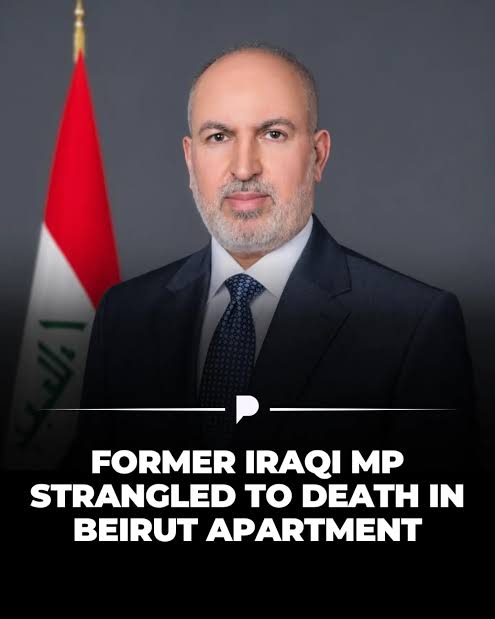
Lebanese authorities are investigating the reported murder of former Iraqi parliamentarian Ahmed al-Alwani in Beirut. Although reports have described suspects and investigative leads, no publicly available final investigative finding has established who ordered the killing, what the motive was or whether any political organisation or foreign state was involved.
The death of former Iraqi parliamentarian Ahmed al-Alwani in Beirut has raised serious questions in Iraq and across the region. However, as the Lebanese investigation continues, the most important questions remain unanswered: who was responsible, why was he killed, and was the crime connected to his political activities?
Al-Alwani was reportedly found dead inside an apartment in Beirut’s Tariq al-Jadideh neighbourhood in November 2026, days after arriving in Lebanon from Erbil, Iraq.
Lebanese security and judicial authorities opened an investigation, with the country’s public prosecutor overseeing the case.
At this stage, the available information does not establish the identity of the person or people who ultimately planned and ordered the killing.
1. What Happened in Beirut?
According to the Associated Press, Al-Alwani arrived in Beirut from Erbil approximately five days before his body was discovered.
Lebanese security and judicial officials told the AP that he initially booked accommodation in the Hamra district before moving to an apartment in Tariq al-Jadideh.
The apartment had reportedly been rented for two days by two Syrian nationals and a Lebanese national.
When the rental period ended and the property agent could not contact him, police were alerted. Authorities subsequently found his body inside the apartment.
The officials said preliminary findings indicated that he had suffered a blow to the head and had been strangled.
These details describe the reported circumstances of the death. They do not, by themselves, establish the motive or the identity of whoever ordered the crime.
2. Lebanese Authorities Are Investigating
Lebanon’s National News Agency reported that the country’s public prosecutor, Judge Ahmed Rami al-Hajj, was overseeing the investigation, which was being conducted by the Internal Security Forces’ Information Branch.
Al Jazeera, citing a Lebanese judicial source, reported that a Lebanese national suspected of involvement had been arrested, while authorities were searching for two Syrian suspects.
Other reports have also described three potential suspects.
However, an arrest or the identification of suspects does not establish guilt. Their individual roles, the evidence against them and the possible existence of anyone who commissioned the crime must be established through the judicial process.
3. Iraq Is Awaiting the Final Investigation Report
Iraqi Ambassador to Lebanon Mohammed Reda al-Husseini said the Iraqi Embassy was following the case closely and remained in contact with Lebanese security agencies.
He said Lebanese judicial authorities had opened an investigation and appointed a judge to follow the case.
The ambassador also said the embassy was waiting for the final report from Lebanese security agencies before announcing the circumstances surrounding the murder.
This is an important point: the Iraqi diplomatic mission itself was awaiting the findings of the Lebanese investigation.
Iraq has also moved to send officials and judicial investigators to Lebanon to follow the case and coordinate with the Lebanese authorities.
4. Questions Have Also Been Raised About Identification and the Victim’s Movements
Reports have raised questions about the circumstances of Al-Alwani’s arrival in Beirut, the people who accompanied him and the movements around the apartment.
The Jerusalem Post reported that the Iraqi Embassy had said DNA testing was needed to confirm the identity of the body because of its condition.
Al-Alwani’s media office also questioned aspects of the reported movements surrounding his arrival and accommodation.
These details require examination by forensic specialists and investigators. Surveillance footage, airport records, telephone data and witness statements could help establish the sequence of events.
Until those findings are made public, conflicting accounts should not be presented as settled facts.
5. Has Anyone Established a Political Motive?
Al-Alwani was a prominent Iraqi politician from Anbar province. He had criticised former Prime Minister Nouri al-Maliki’s government and Iranian influence in Iraq. He also played an important role in the Sunni protest movement of 2012–2013.
His political background makes a political motive one possible line of inquiry.
But a person’s political position is not evidence that a political rival or organisation ordered their murder.
A financial dispute, personal conflict, criminal conspiracy or political motive are all possibilities that investigators may examine. None should be declared the explanation without supporting evidence.
As of the reports examined for this article, no final official finding has established the motive.
6. No Publicly Established Evidence Identifies Iran or Hezbollah as Responsible
Al-Alwani’s criticism of Iranian influence in Iraq has led some commentators and media outlets to raise questions about possible involvement by Iran-backed organisations, including Hezbollah.
Such questions may be investigated if credible evidence supports them.
However, the publicly available reports examined for this article do not establish that Iran, Hezbollah, Kataib Hezbollah or another political or armed organisation planned, ordered or carried out the killing.
The Jerusalem Post itself acknowledged in its November 11 analysis that investigators had not provided conclusions about the suggested Hezbollah-related possibilities.
That distinction must be maintained.
An allegation, a political theory or an analysis of regional influence cannot replace forensic evidence, verified communications, financial records, credible witness testimony or an official investigative conclusion.
The absence of publicly available proof does not establish that an organisation had no involvement. It means that responsibility has not been demonstrated in the public record.
7. What Must Investigators Establish?
For the case to reach a credible conclusion, Lebanese authorities and their Iraqi counterparts need to establish several key facts:
- The confirmed identity of the victim through the required forensic procedures.
- The precise time and location of the killing.
- The movements of the victim and the people who accompanied him.
- The identities and individual roles of all suspects.
- The communications and financial transactions connected to the crime.
- Whether the killing was motivated by politics, money, a personal dispute or another reason.
- Whether anyone outside the immediate suspects planned, financed or ordered the crime.
The investigation must also distinguish between those who physically carried out the killing and anyone who may have organised or facilitated it.
8. The Principle: No Accusation Without Evidence
The murder of a former parliamentarian is a serious crime that deserves a transparent and thorough investigation.
His political history should not be ignored. Nor should it be used as a shortcut to accuse a country, government or armed organisation.
If evidence eventually establishes the involvement of a political faction, an armed group, a foreign government or individual perpetrators, those responsible must face accountability.
If the evidence establishes a different motive, that finding must also be reported.
The public deserves the truth, not premature conclusions.
At present, the central questions remain open: who killed Ahmed al-Alwani, who planned the crime, and why was he targeted? Until investigators establish the answers, responsibility must not be assigned without evidence.
Sources & References
- Associated Press – Lebanese officials: Former Iraqi MP Ahmed al-Alwani killed in Beirut
- Al Jazeera – Former Iraqi lawmaker Ahmed al-Alwani found dead in Beirut, November 11, 2026
- MTV Lebanon – Iraqi ambassador awaits final Lebanese security report
- The New Arab – Iraq sends investigators to Beirut over killing of former MP
- Anadolu Agency – Former Iraqi lawmaker killed in Beirut, probe launched
- The Jerusalem Post – Who killed Ahmed al-Alwani? Beirut murder raises regional questions – analysis
THE WORLD’S UPDATE
Standing with the oppressed. Speaking for the unheard. Seeking truth without fear.