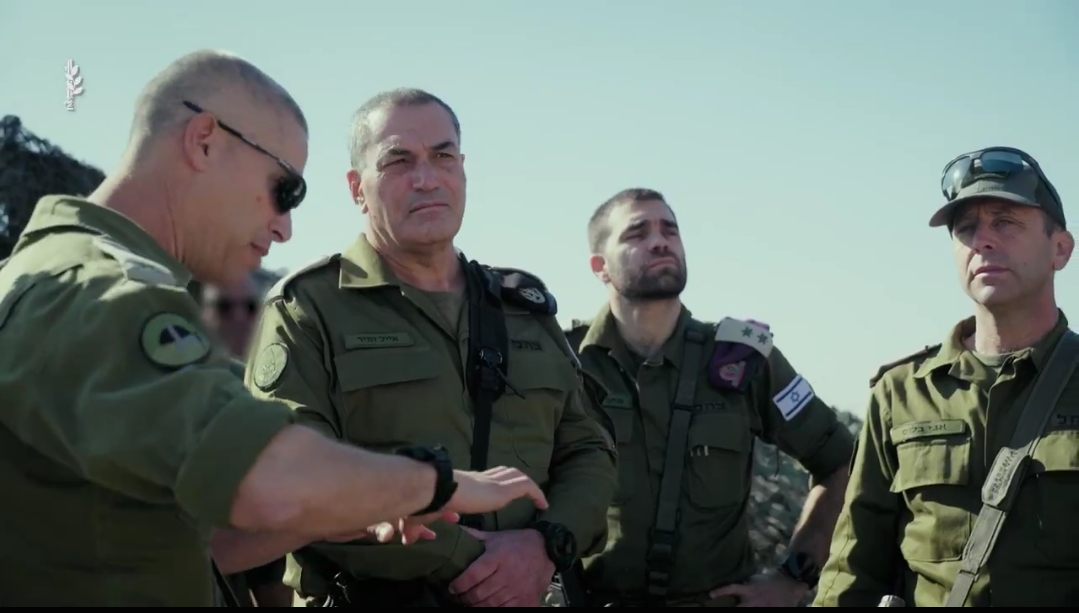
IDF Chief of Staff Eyal Zamir has described control of the Jordan Valley as essential to Israel’s national security and strategic depth. His remarks explicitly connect military deployment with stronger settlements, agriculture and civilian presence in the occupied West Bank.
A Military Visit With a Wider Political Message
On November 11, 2026, Israeli Chief of Staff Lieutenant General Eyal Zamir visited military positions along the Jordanian border and the area under the responsibility of the newly established 96th Division.
He was accompanied by senior military commanders and officials from Israel’s Ministry of Defense.
During the visit, Zamir inspected military outposts and a security barrier currently under construction. He also received an operational briefing and issued instructions concerning military readiness and the implementation of Israel’s defensive strategy.
The visit was presented by the Israeli military as part of efforts to strengthen border security following the October 7, 2023 attacks.
But Zamir’s political and strategic remarks deserve particular attention.
1. The Jordan Valley Is More Than a Border-Security Issue
Zamir described the Jordan Valley as having historical, Zionist and security significance.
He called it Israel’s “eastern protective wall” and said that control over the region was essential to national security and strategic depth.
This language is significant because the Jordan Valley is not simply an internationally recognised border area.
It includes territory inside the occupied West Bank, where Palestinian communities live and where Israeli settlements have been established.
The International Court of Justice has stated that Israel’s continued presence in the Occupied Palestinian Territory is unlawful and that new settlement activity must cease.
Therefore, any military or infrastructure project operating inside the occupied territory must also be examined in the context of occupation law and Palestinian rights.
2. The Military and Settlement Systems Are Being Connected
One of the most revealing parts of Zamir’s statement was his description of what makes the region secure.
He said security depends not only on military forces and fortifications, but also on:
- Strong settlements.
- Thriving agriculture.
- Civilian communities establishing roots in the land.
- Cooperation between military, civilian and settlement systems.
This is more than a statement about protecting military positions.
It openly presents civilian settlement and agricultural development as components of Israel’s regional security strategy.
The distinction matters because Israeli settlements in the occupied West Bank are considered illegal under international law.
Article 49(6) of the Fourth Geneva Convention prohibits an occupying power from transferring parts of its own civilian population into the territory it occupies.
The ICJ’s 2024 advisory opinion also addressed Israel’s settlement policy and its obligations to end its unlawful presence in the occupied Palestinian territory.
3. Division 96 and the New Military Barrier
The 96th Division is responsible for a broad section of Israel’s eastern frontier, including a section of the Jordan Valley inside the occupied West Bank.
According to the Israeli military, the division is developing forward military positions and improving intelligence collection and offensive capabilities.
The new barrier is also part of the construction programme being implemented in the division’s area.
These developments raise important questions about the location and impact of the infrastructure.
A security barrier built along an internationally recognised border is legally different from one that extends into occupied territory.
Where a barrier runs inside the West Bank, its route, restrictions on Palestinian movement, land access and impact on local communities require scrutiny.
The UN Office for the Coordination of Humanitarian Affairs has previously explained that sections of Israel’s barrier running inside the West Bank, together with the associated gate and permit system, are unlawful under international law.
4. The Contradiction Between Promises of Protection and Conditions on the Ground
During the visit, Zamir instructed commanders to maintain law and order and protect the security of all population groups living in the region.
That statement should be judged against the actual situation faced by Palestinian communities.
Reports from the occupied West Bank have repeatedly documented settler violence, restrictions on movement, displacement and damage to Palestinian property.
The protection of all residents must mean equal protection in practice, not merely a statement made during a military briefing.
If the military is strengthening its presence to protect civilians, it must also prevent attacks against Palestinians, investigate violence by illegal settlers and ensure that Palestinian residents can access their homes, agricultural land and essential services.
Security cannot be used as a justification for denying another population its basic rights.
5. What Does This Strategy Mean for Palestinians?
Zamir’s remarks bring three elements together:
- Military control: More forward positions, intelligence collection and operational readiness.
- Infrastructure: A new barrier and stronger border installations.
- Settlement consolidation: Stronger settlements, agricultural activity and civilian communities putting down roots.
The combination deserves close monitoring.
The key question is whether military and infrastructure developments will remain confined to legitimate border-security needs or further entrench Israel’s control over occupied Palestinian territory.
Any project that affects Palestinian land, movement, homes or access to resources must be assessed under international law.
6. Questions That Require International Attention
The Israeli government and military should clarify:
- What is the exact route of the new eastern barrier?
- Which sections are located inside the occupied West Bank?
- How much Palestinian land will be affected?
- Will Palestinian farmers retain access to their agricultural land?
- What protections will be provided against illegal settler violence?
- How will the military ensure equal protection for Palestinian residents?
- What is the relationship between the division’s military deployment and the stated objective of strengthening settlements?
These are not minor administrative questions. They concern land, movement, civilian protection and the future of Palestinian communities.
The World’s Update: Security Cannot Become a Cover for Permanent Control
Israel has the right to protect civilians from genuine security threats. But that right does not cancel the rights of Palestinians living under occupation.
A military strategy that openly connects control of the Jordan Valley with settlement strength, agricultural development and civilian expansion must be examined beyond its security language.
The Jordan Valley is home to Palestinian communities whose rights cannot be erased by military plans or political claims of strategic depth.
The international community must closely examine the new barrier, the expansion of military positions and the relationship between military and settlement infrastructure.
Security for one population cannot lawfully be built on the dispossession, restriction or permanent subordination of another.
Sources & References
- Original post — Captain Ella: Eyal Zamir’s visit to the eastern border and 96th Division, November 11, 2026
- Israel Defense Forces — Official statement on the Chief of Staff’s visit to the eastern border and Division 96, November 11, 2026
- The Times of Israel — On Jordan border, Zamir says IDF must prepare for rapid changes and surprise, November 11, 2026
- International Court of Justice — Legal Consequences arising from the Policies and Practices of Israel in the Occupied Palestinian Territory, July 19, 2024
- UN OCHA — Movement and Access in the West Bank, April 2026
- International Committee of the Red Cross — International Humanitarian Law and the Occupying Power’s Responsibilities in the Occupied Palestinian Territory
THE WORLD’S UPDATE
Standing with the oppressed. Speaking for the unheard. Seeking truth without fear.