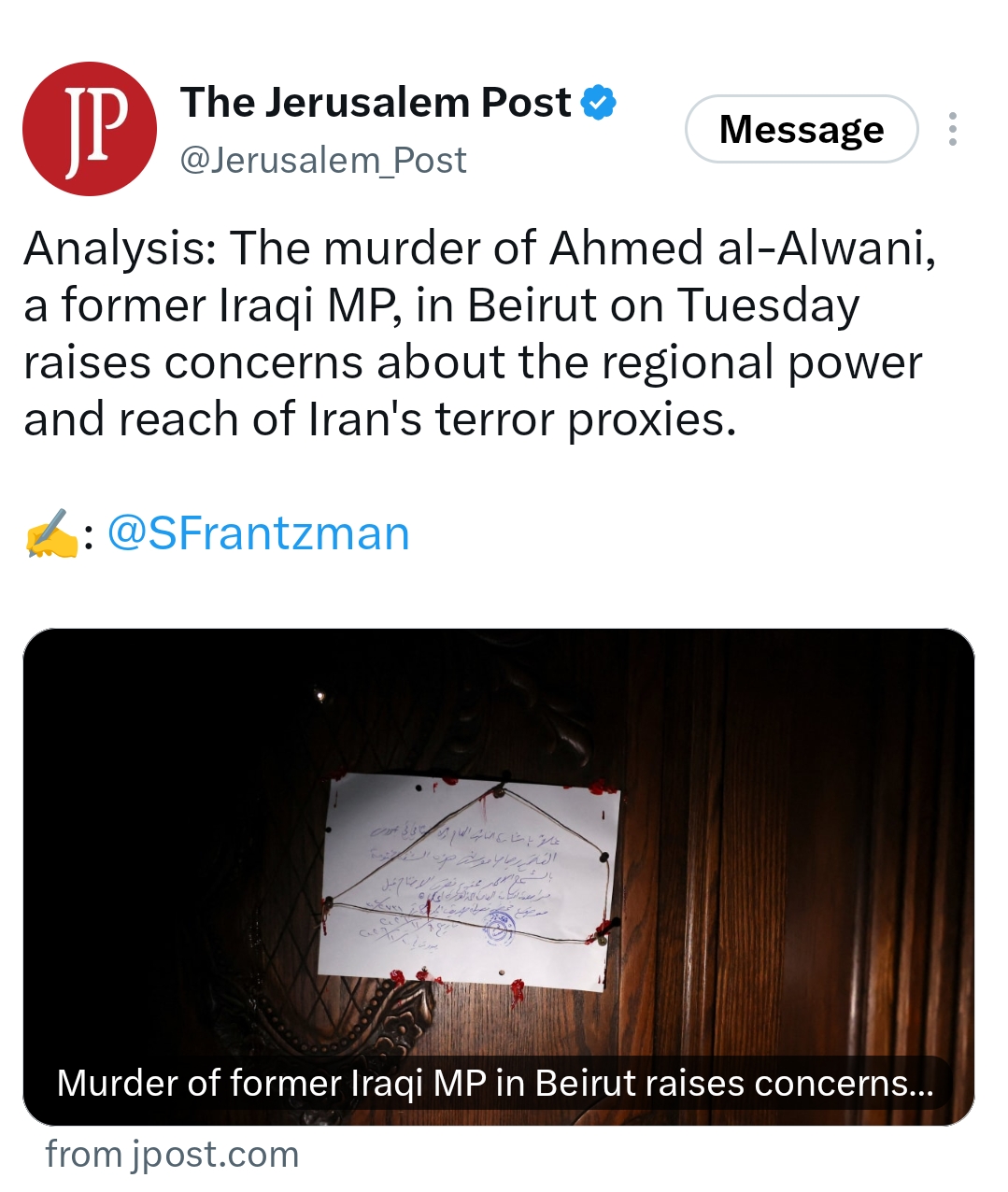
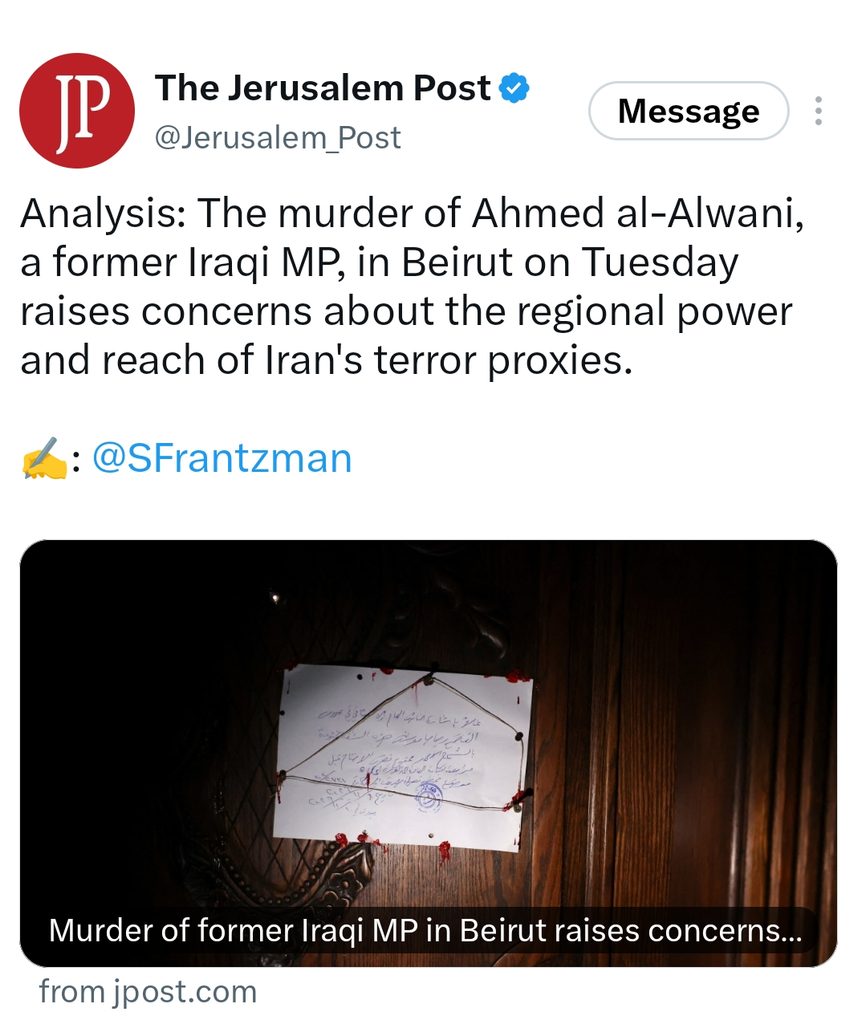
The Jerusalem Post connected the murder of former Iraqi MP Ahmed al-Alwani in Beirut with the regional influence of Iran-backed groups and raised questions about possible Hezbollah connections. But Lebanese investigators have not publicly established an Iranian or Hezbollah connection. The Iraqi Embassy is still awaiting the final investigation report. So where is the evidence behind the political framing?
THE WORLD’S UPDATE | FACT CHECK & MEDIA ACCOUNTABILITY
A former Iraqi parliamentarian was murdered in Beirut. His death demands a serious criminal investigation, identification of the perpetrators and accountability for everyone involved.
But instead of keeping the central question focused on the evidence, The Jerusalem Post published analysis connecting the killing to Iran-backed groups and possible Hezbollah involvement.
This raises a fundamental question about responsible journalism:
Can a major international media organisation use an unresolved murder investigation to reinforce a political narrative about Iran and Hezbollah without presenting evidence that connects either organisation to the crime?
THE WORLD’S UPDATE examined the Jerusalem Post coverage alongside reporting from the Associated Press, Al Jazeera and statements attributed to Iraqi and Lebanese authorities.
The result exposes a major gap between the political suspicions raised in the analysis and what investigators have publicly established.
1. What Did The Jerusalem Post Actually Claim?
In an article published on November 11, 2026, under the headline:
“Who killed Ahmed al-Alwani? Beirut murder raises regional questions – analysis”
Jerusalem Post journalist Seth J. Frantzman raised questions about possible political and sectarian motives and whether Kataib Hezbollah in Iraq could have worked with Hezbollah in Lebanon to target Al-Alwani.
The article also questioned Lebanon’s ability to prosecute Hezbollah members and placed the murder within the wider context of Iranian-backed factions and regional influence.
A separate Jerusalem Post headline published on November 12 went further in its framing:
“Murder of former Iraqi MP in Beirut raises concerns about power of Iran-backed terror – analysis.”
These are significant editorial choices. They direct the reader towards a particular political interpretation of a murder whose perpetrators and motive had not yet been established publicly.
But what evidence did the article present to connect Iran or Hezbollah to this specific crime?
That is the central issue in this fact check.
2. The Most Important Admission Is Inside Jerusalem Post’s Own Article
There is a crucial passage in the November 11 analysis.
The Jerusalem Post wrote:
“None of these possibilities has been explained by investigators, and no conclusions have been provided to the media.”
This admission is important.
The article itself acknowledges that investigators had not established the suggested Hezbollah connection or provided conclusions supporting the proposed theories.
In other words, the article raised the possibility of Hezbollah involvement without presenting an official investigative finding establishing that connection.
There is nothing inherently wrong with investigating a possible political motive. Journalists are entitled to ask difficult questions.
But a possibility is not proof. An analytical question is not an investigative conclusion.
When a headline places Iran-backed groups and terrorism at the centre of an unresolved murder story, readers deserve to know whether that connection is supported by evidence or is simply an editorial hypothesis.
3. What Did Lebanese Authorities Actually Establish?
The Associated Press reported that Lebanese security and judicial officials said Al-Alwani had been found dead in an apartment in Beirut.
According to the AP report:
- He had arrived in Beirut from Erbil several days earlier.
- He initially booked accommodation in the Hamra district before moving to an apartment in Tariq Jadida.
- The apartment had reportedly been rented by two Syrian nationals and one Lebanese national.
- Police found him dead after he had suffered a blow to the head and had been strangled.
- Investigators were questioning the taxi driver who collected him from the airport and searching for the people who rented the apartment.
Al Jazeera, citing AFP and a Lebanese judicial source, reported that a Lebanese suspect had been arrested and two Syrian suspects were being sought.
These are investigative details concerning the circumstances of the murder and people suspected of involvement.
Neither report establishes that Iran, Hezbollah or Kataib Hezbollah ordered or carried out the killing.
The distinction is essential: the existence of suspects in a murder investigation does not establish the involvement of an organisation that has not been linked to the crime by publicly presented evidence.
4. The Iraqi Embassy Was Still Waiting for the Final Report
Another important piece of information came from Iraq’s Ambassador to Lebanon, Mohammed Reda al-Husseini.
The ambassador said the Iraqi Embassy was in contact with Lebanese security agencies and was awaiting the final report before disclosing the circumstances of the murder.
He also said that the Lebanese judiciary had opened an investigation and appointed a judge to follow the case.
This is a significant point.
If the Iraqi Embassy itself was waiting for the final Lebanese investigation report, how could an external political analysis establish a connection between the murder and Iran-backed organisations without showing the evidence for that connection?
The Jerusalem Post was free to raise questions. But those questions should not be confused with the findings of Lebanese investigators.
5. Al-Alwani’s Opposition to Iran Does Not Prove Iran Was Behind His Murder
Ahmed al-Alwani was known for his opposition to former Iraqi Prime Minister Nouri al-Maliki and Iranian influence in Iraq.
He also criticised Iranian-backed armed factions and rose to prominence during the Sunni protest movement of 2012–2013.
That political background is relevant to understanding his life and the possible motives investigators may examine.
However, there is a serious logical problem with using his political position as evidence of responsibility for his murder.
A person’s criticism of a government or armed organisation does not prove that the organisation killed that person.
If political opposition alone were sufficient evidence, almost any murder of a political critic could be attributed to the government or group that the victim opposed.
That is not investigative journalism. It is an assumption that must be tested, not a conclusion that can be published as established fact.
6. What Evidence Would Be Needed to Establish an Iran or Hezbollah Connection?
A serious investigation would need evidence connecting specific individuals to the crime and, separately, establishing whether an organisation directed, financed or facilitated it.
Relevant evidence could include:
- Verified communications between suspects and members of an organisation.
- Financial records showing payments connected to the operation.
- Forensic evidence and authenticated surveillance footage.
- Witness testimony independently corroborated by investigators.
- A documented chain of command or operational instructions.
- An official investigative finding identifying the organisation’s role.
The Jerusalem Post article did not publicly present such evidence establishing Iranian or Hezbollah responsibility.
This does not prove that no such evidence exists privately or that investigators will never discover a connection.
It means the public claim remains unsubstantiated on the material presented to readers.
7. A Wider Question About Media Responsibility
This case raises an issue that extends beyond one newspaper.
Major media organisations have enormous influence over how international audiences understand the Middle East.
Their headlines can shape public perceptions of Iran, Hezbollah, Iraq, Lebanon and other regional actors.
That influence comes with an obligation to distinguish verified facts from allegations and editorial interpretation.
The same standard should apply whether the subject is Iran, Israel, the United States, Saudi Arabia, Hezbollah or any other political or military actor.
A media outlet cannot demand evidence from governments and armed groups while treating its own political assumptions as sufficient grounds for public suspicion.
The question is not whether Iran or Hezbollah should be protected from scrutiny. Any credible evidence of involvement must be investigated.
The question is whether the public has been shown evidence that justifies connecting these organisations to Ahmed al-Alwani’s murder.
As of the reporting examined for this fact check, no publicly available Lebanese investigative conclusion establishes that connection.
8. FACT-CHECK VERDICT
CLAIM UNDER REVIEW: The framing that Ahmed al-Alwani’s murder raises evidence-based concerns about Iran-backed groups and possible Hezbollah involvement.
WHAT THE EVIDENCE SHOWS:
- The murder was being investigated by Lebanese authorities.
- Suspects were being pursued and at least one Lebanese suspect was reported arrested.
- The Iraqi Embassy was awaiting the final Lebanese investigation report.
- The Jerusalem Post itself acknowledged that investigators had not provided conclusions about the proposed Hezbollah-related possibilities.
- No publicly presented official finding in the reports examined established Iranian or Hezbollah involvement.
VERDICT: UNSUBSTANTIATED — MISLEADING POLITICAL FRAMING.
The Jerusalem Post was entitled to raise questions about possible political motives. However, its Iran-Hezbollah framing was not supported by a publicly presented investigative finding linking either organisation to the murder.
Calling the allegation definitively false would go beyond the available evidence. The accurate conclusion is that the connection remains unproven and should not be presented to readers as an established explanation.
9. The Question The Jerusalem Post Must Answer
Being a major international newspaper does not make every analysis an established fact.
If a media organisation raises the possibility that Iran-backed groups or Hezbollah were involved in a murder, it should clearly explain what evidence supports that possibility.
If investigators have not established the connection, readers deserve to know that prominently and without ambiguity.
Does being a major media house mean that a newspaper can direct public suspicion towards any country or organisation on the basis of political theories, without presenting evidence that connects them to the crime?
The murder of Ahmed al-Alwani deserves a proper investigation, not a premature political verdict.
THE WORLD’S UPDATE calls for transparency from Lebanese investigators and accountability for whoever is ultimately proven responsible.
No country, political faction or armed organisation should be above investigation. But no country or organisation should be accused of murder without evidence either.
Evidence must come before accusation. Journalism must come before political narrative.
Sources & References
- The Jerusalem Post – Who killed Ahmed al-Alwani? Beirut murder raises regional questions – analysis, November 11, 2026
- The Jerusalem Post – Murder of former Iraqi MP in Beirut raises concerns about power of Iran-backed groups, November 12, 2026
- Associated Press – Lebanese officials: Former Iraqi MP Ahmed al-Alwani killed in Beirut
- Al Jazeera – Former Iraqi lawmaker Ahmed al-Alwani found dead in Beirut, November 11, 2026
- MTV Lebanon – Iraqi ambassador awaits final Lebanese security report on Al-Alwani’s murder
THE WORLD’S UPDATE
Standing with the oppressed. Speaking for the unheard. Seeking truth without fear.