By MD MOHMMAD ABBAS
THE WORLD’S UPDATE
November 19, 2026
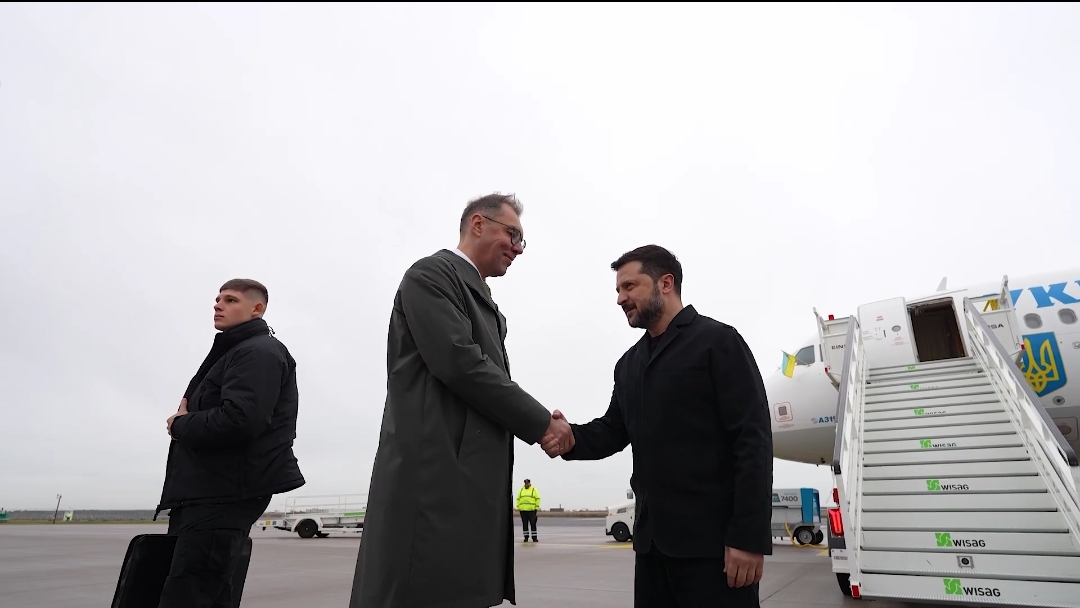
BERLIN, Germany — Ukrainian President Volodymyr Zelenskyy has arrived in Berlin to participate in a high-level meeting of the Coalition of the Willing, where European leaders and international partners are discussing continued support for Ukraine, post-war security guarantees and the next steps towards ending the Russia-Ukraine war.
The meeting, hosted by German Chancellor Friedrich Merz on November 19, brings together representatives from 37 countries, alongside senior officials from the European Union and NATO, according to the German government.
The gathering comes at a sensitive diplomatic moment, as US President Donald Trump, Russian President Vladimir Putin and Chinese President Xi Jinping are also holding talks in China.
Zelenskyy Seeks Stronger Security and European Participation
Upon arriving in Berlin, Zelenskyy said Ukraine’s priorities include strengthening the protection of its airspace, securing energy infrastructure, obtaining financial support and advancing diplomatic efforts to end the war.
He also stressed the importance of ensuring Europe’s full participation in the negotiation process.
Ukraine is expected to use the meeting to coordinate its position with European partners and discuss the next phase of international negotiations.
US Envoys Join the Berlin Discussions
US President Donald Trump’s special envoys, Steve Witkoff and Jared Kushner, are also travelling to Berlin for consultations with Zelenskyy and European leaders.
Kushner said the objective is to strengthen coordination between Washington, Kyiv and European partners, develop a common position on the key elements of lasting peace and prepare the agenda and proposed format for the next round of multilateral negotiations.
Their participation is particularly significant because the United States has been conducting diplomatic discussions with both Ukraine and Russia.
What Security Guarantees Are Being Discussed?
One of the central issues at the Berlin meeting is the possibility of robust and legally binding security guarantees for Ukraine after a ceasefire.
According to the German government, discussions include the proposed establishment of a Multinational Force Ukraine, which could support the regeneration of Ukraine’s armed forces and contribute to post-war security arrangements.
A proposal outlined by French officials includes three main elements:
- Continued support for the Ukrainian Armed Forces as the country’s first line of defence.
- A possible multinational force deployed under the Coalition of the Willing after hostilities end.
- Strong legal and political security guarantees intended to reduce the risk of another attack.
These are proposals under discussion, not confirmation that foreign troops have been authorised to deploy in Ukraine.
Europe Wants a Place at the Negotiating Table
The Berlin meeting also reflects European concerns about being excluded from decisions concerning the future of European security.
Ukraine’s European partners have pushed for a direct role in US-backed negotiations with Moscow. The timing of the summit is intended to help European leaders coordinate their response to developments from the Trump-Putin-Xi meeting in China.
Reuters reported that Germany, France, Britain, Poland and Italy are among the key European participants, with NATO Secretary-General Mark Rutte also expected to attend.
Britain has indicated that it will announce further support for Ukraine, including long-range drones and surveillance and logistical equipment.
The Russia Question Remains Unresolved
Despite renewed diplomatic activity, major differences remain between Moscow and Kyiv.
Russia has continued to demand control over the Donbas region, while Ukraine has resisted surrendering its territory.
The Berlin meeting is therefore focused not only on supporting Ukraine militarily and financially, but also on shaping the conditions under which any future ceasefire or peace arrangement could be secured.
No final peace agreement or confirmed deployment of multinational forces has been announced in the reports available at the time of publication.
What Comes Next?
The immediate challenge for the participating countries is to coordinate a common diplomatic position while ensuring that Ukraine remains directly involved in decisions about its own future.
The discussions in Berlin, alongside the separate talks involving Trump, Putin and Xi in China, could influence the next phase of diplomatic engagement.
However, whether these meetings lead to concrete progress towards a ceasefire will depend on the positions taken by Russia, Ukraine and the countries involved in the negotiations.
Sources and verification:
- German Federal Government — Official announcement and agenda of the November 19 Coalition of the Willing meeting: https://www.bundesregierung.de/breg-de/aktuelles/koalition-der-willigen-in-berlin-2461162
- Reuters — Ukraine’s European allies meet in Berlin in show of support, November 19, 2026: https://www.reuters.com/world/china/ukraines-european-allies-meet-berlin-show-support-2026-11-19/
- UNN — Zelenskyy arrives in Berlin for Coalition of the Willing meeting: https://unn.ua/en/news/zelenskyy-arrived-in-berlin-for-a-meeting-of-the-coalition-of-the-willing-and-with-trumps-envoys
- Ukrinform — Witkoff and Kushner travel to Berlin for consultations: https://www.ukrinform.net/rubric-polytics/4186320-witkoff-kushner-heading-to-berlin-for-coalition-of-the-willing-meeting.html
- European Pravda — Discussion of possible multinational forces in Ukraine: https://www.pravda.com.ua/eng/news/2026/11/18/8063472/
THE WORLD’S UPDATE
Standing with the oppressed. Speaking for the unheard. Seeking truth without fear.