By MD MOHMMAD ABBAS
THE WORLD’S UPDATE
November 19, 2026
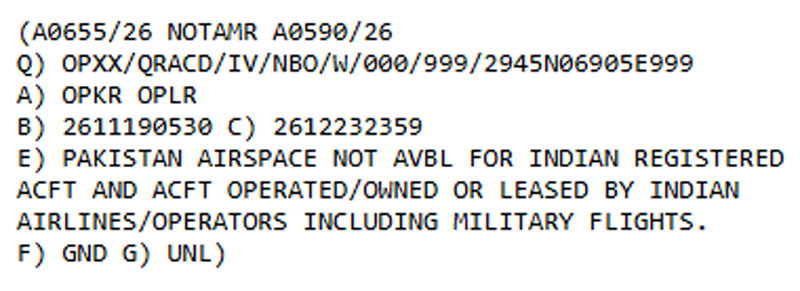
ISLAMABAD — Pakistan has extended its airspace restrictions on Indian aircraft until December 23, 2026, according to a fresh Notice to Airmen (NOTAM) issued by the Pakistan Airports Authority (PAA) on November 19.
The restriction applies to aircraft registered in India, as well as aircraft owned, operated or leased by Indian airlines and operators. It also explicitly includes military flights.
The newly issued NOTAM, identified as A0655/26, replaces the previous notice and applies to both Pakistan’s Karachi (OPKR) and Lahore (OPLR) Flight Information Regions.
According to the aviation notice, the restriction remains effective until 23:59 UTC on December 23, 2026.
Which Aircraft Are Affected?
The restriction covers:
- All aircraft registered in India.
- Aircraft owned by Indian airlines or operators.
- Aircraft operated by Indian airlines or operators.
- Aircraft leased by Indian airlines or operators.
- Indian military flights.
The restriction applies across both Karachi and Lahore airspace regions.
The NOTAM does not mean that every international airline flying between India and other countries is automatically prohibited from using Pakistani airspace. Its wording specifically identifies Indian-registered aircraft and aircraft connected to Indian airlines or operators.
Why Has Pakistan Extended the Restriction?
Pakistan initially imposed the airspace restriction in April 2025, following a major deterioration in relations between New Delhi and Islamabad after the Pahalgam attack in Jammu and Kashmir.
The two countries subsequently experienced a serious military confrontation in May 2025 before a ceasefire was announced.
Since then, restrictions on each other’s airspace have continued through periodic extensions, affecting airline operations and international flight routes.
Economic Impact on Indian Airlines
The continued closure forces affected Indian carriers to use alternative flight routes when travelling to certain international destinations.
Longer routes can increase:
- Aircraft fuel consumption.
- Flight duration.
- Operating and crew costs.
- Scheduling and logistical challenges.
Air India has previously reported substantial financial and operational effects associated with the longer routes resulting from Pakistan’s airspace restrictions.
The additional costs can be particularly significant for long-haul flights connecting India with Europe and other western destinations.
What Happens Next?
The latest NOTAM keeps the restriction in place until December 23, 2026, at 23:59 UTC.
Unless Pakistan issues another notice changing or extending the restriction, the current NOTAM will remain applicable until that deadline.
The repeated extensions demonstrate that the aviation restrictions remain part of the continuing India-Pakistan diplomatic tensions.
For airlines and passengers, the situation means that alternative flight planning and longer routes may continue to affect some international journeys.
OFFICIAL DOCUMENT AND SOURCES
- Pakistan Airports Authority NOTAM A0655/26 — Official aviation restriction text: https://notamify.com/notams/OPLR/fb891816-eee9-4c53-a526-029a010f128a
- Dawn — Pakistan extends airspace ban on Indian aircraft until December 23, November 19, 2026: https://www.dawn.com/news/2045680/airspace-ban-on-indian-aircraft-extended-till-dec-23
- Business Recorder — Indian aircraft barred from Pakistani airspace, November 19, 2026: https://www.brecorder.com/news/40449738/indian-aircraft-barred-from-pakistani-airspace-until-dec-24
- International Civil Aviation Organization (ICAO) — India-Pakistan Airspace Contingency Coordination Team bulletin: https://www.icao.int/sites/default/files/APAC/Meetings/2025/2025%20%E2%80%8BIndia-Pakistan%20Airspace%20Contingency/India-Pakistan-Airspace-CCT-Bulletin-1.pdf
THE WORLD’S UPDATE
Standing with the oppressed. Speaking for the unheard. Seeking truth without fear.