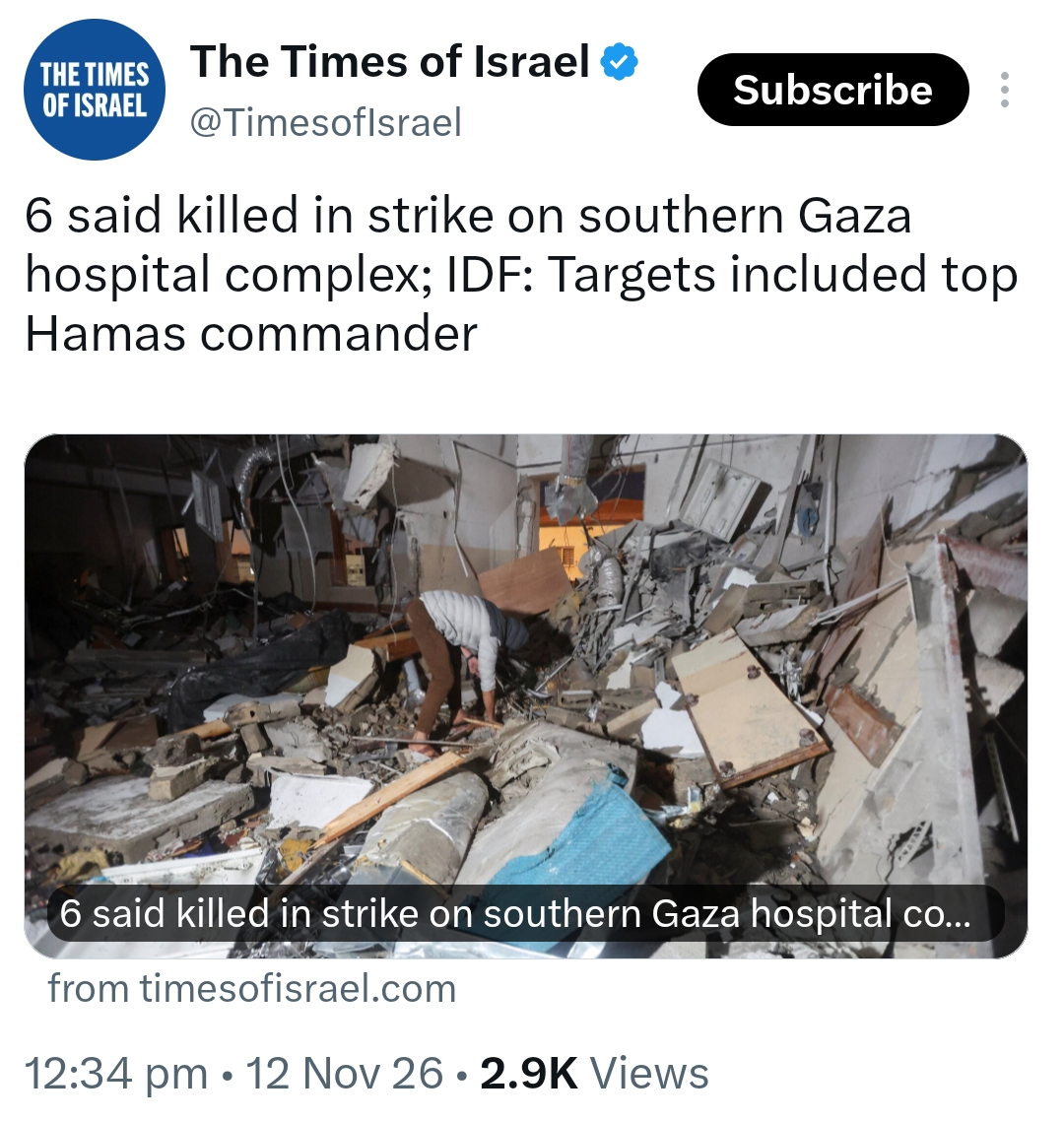
THE WORLD’S UPDATE investigates the November 12, 2026 Israeli strike on Nasser Hospital, the reported deaths of six Palestinians including a surgeon, and the conflicting presentation of the alleged Hamas commander’s fate. The available public evidence does not independently establish that Muhammad Abu Ismail was present at the hospital or was killed in the strike.
Author, Writer & Editor: MD MOHMMAD ABBAS
Affiliation: THE WORLD’S UPDATE
Date: November 12, 2026
Report Type: Independent Investigation and Evidence Review
KEY FINDING
The Israeli military and Shin Bet identified Muhammad Abu Ismail, described as the commander of Hamas’s Khan Younis Brigade, as the intended target of the Nasser Hospital strike.
However, the publicly available material reviewed for this investigation does not independently establish that Abu Ismail was present at the hospital when it was attacked or that he was killed.
The Jerusalem Post published a headline presenting the commander’s death as an established outcome. The Times of Israel, however, explicitly reported that his fate remained unclear and that the results of the strike were still under review.
Meanwhile, the Associated Press and Reuters reported six Palestinian deaths, including a surgeon, and damage to the hospital’s surgical facilities.
1. What happened at Nasser Hospital?
An Israeli airstrike hit the Nasser Hospital complex in Khan Younis, southern Gaza, early on November 12, 2026.
The Associated Press reported that six Palestinians were killed and at least 28 wounded, citing Gaza’s Health Ministry. Among those killed was general surgeon Rizk Abu Shaira.
Reuters also reported six deaths, including surgeon Rezik Abushira, and 20 injured, citing Gaza Civil Defence spokesperson Mahmoud Basal. Reuters described extensive damage to the surgery department, with debris, damaged ceilings and injured patients being evacuated through the affected building.
The casualty figures and spelling of the surgeon’s name differ slightly between the reports. Both agencies reported six deaths and identified a surgeon among those killed.
These are reported casualty figures, attributed to the Palestinian authorities and medical sources cited by the news agencies.
The central question of this investigation is not whether Israel carried out the strike. It is whether the Israeli military has substantiated its explanation for attacking a protected medical facility.
2. Israel’s claim: A Hamas commander and other operatives were targeted
The Israel Defense Forces (IDF) and Shin Bet stated that the strike targeted Muhammad Abu Ismail, whom they identified as the commander of Hamas’s Khan Younis Brigade.
Their statements alleged that Hamas operatives had established a presence inside the hospital complex and used it for:
- Military command-and-control operations.
- Weapons and ammunition storage.
- Observation posts and shelters for operatives.
- Interrogations and alleged torture by Hamas security and intelligence personnel.
The IDF also said it had used precision munitions and aerial surveillance to reduce civilian harm.
These allegations are serious and require examination. However, an official military statement establishes what the military claims; it does not independently prove that the alleged activities were taking place at Nasser Hospital at the time of the November 12 strike.
The evidence question remains: what independently verifiable material establishes the alleged commander’s presence and the hospital’s alleged military use at the time of the attack?
3. Where is the proof that the commander was present or killed?
The IDF and Shin Bet identified Muhammad Abu Ismail as their intended target.
However, The Times of Israel’s November 12 update explicitly reported:
- Abu Ismail’s fate was unclear.
- The results of the overnight strike were still under review by the military and Shin Bet.
This is a crucial distinction.
Identifying someone as an intended target does not establish that the person was physically present at the location, that the strike hit them, or that they died.
The material reviewed for this investigation has not identified publicly released forensic confirmation, independently verified identification of his remains, or other conclusive evidence establishing his death.
The absence of publicly released body footage does not, by itself, prove that he was absent or survived. However, without verifiable evidence, his presence and death cannot responsibly be reported as established facts.
4. Examining The Jerusalem Post and The Times of Israel reports
The reporting by the two Israeli media outlets requires careful comparison.
The Jerusalem Post: Death presented in the headline
The Jerusalem Post published its November 12 report under the headline:
“IDF kills Hamas terrorists, incl. brigade chief, plotting attacks from Khan Yunis’s Nasser Hospital.”
The article identified Muhammad Abu Ismail as the Khan Younis Brigade commander and attributed the description of his role, the alleged Hamas presence and the hospital’s alleged military use to the IDF and Shin Bet.
It also reported that the IDF had not announced a specific casualty figure at the time of publication.
The headline presents the commander’s death as an established outcome. However, the article does not provide independent forensic confirmation of his death.
The Times of Israel: The commander’s fate remained unclear
The Times of Israel published two relevant updates.
Its earlier report said the IDF and Shin Bet had targeted a senior Hamas commander and other operatives at Nasser Hospital. It also said the results of the strike were still under review.
Its subsequent update identified Muhammad Abu Ismail as the intended target but explicitly stated that his fate was unclear.
This means the two outlets did not present the commander’s fate in the same way.
The Jerusalem Post’s headline stated that the brigade chief had been killed. The Times of Israel’s later report said his fate remained unclear.
Neither outlet’s publication, by itself, constitutes independent forensic verification of the military’s account.
Our finding: The Jerusalem Post’s headline conveys greater certainty about the commander’s death than the publicly reported evidence establishes. The Times of Israel’s own update does not confirm his death.
5. What independent reporting actually establishes
The Associated Press reported six deaths, including a surgeon, and at least 28 wounded. It also reported that the Israeli military said it had struck a Hamas commander and other militants, without providing evidence in that report.
Reuters reported six deaths, including a surgeon, and 20 injured. Its reporting documented extensive physical damage to the hospital’s surgical department.
Reuters also stated that it could not independently verify the Israeli military’s allegations about Hamas using the hospital as a command centre, weapons store and observation post.
These reports establish the publicly reported civilian and medical casualties and document damage to the hospital.
They do not independently establish that Muhammad Abu Ismail was present at the hospital or that he was killed in the strike.
6. The missing evidence
For the Israeli military’s explanation to be independently assessed, the following material would be relevant:
- Evidence of presence: Verifiable material establishing that Muhammad Abu Ismail was physically present at Nasser Hospital when the strike occurred.
- Evidence of death: Reliable identification or forensic confirmation establishing whether he was killed.
- Evidence of military use: Dated and location-verified material showing the alleged command centre, weapons storage or other military activity at the hospital at the time of the attack.
- Evidence of precautions: Information explaining the target-selection process, the precautions taken to protect patients and medical staff, and the anticipated civilian harm.
- Warning and evacuation: Evidence concerning whether the applicable legal warning requirements were met and whether patients and medical personnel had a safe opportunity to leave, where required.
The public statements and material reviewed for this investigation do not independently establish these points.
The burden of substantiating the military’s specific claims cannot be met merely by repeating them in official statements or media headlines.
7. The hospital director’s account
The Jerusalem Post also reported that Nasser Hospital’s director spoke to Al Jazeera after the strike and claimed that the “entire facility has been rendered unusable.”
The director reportedly stated that the hospital served approximately one million residents and was the only medical centre in the area performing surgeries.
This is an account attributed by The Jerusalem Post to the hospital director’s interview with Al Jazeera. THE WORLD’S UPDATE has not independently verified the full extent of the claimed loss of functionality.
Nevertheless, the reported damage to the surgical department and the evacuation of injured patients underline the serious medical consequences of the strike.
8. International humanitarian law: Protection of hospitals
Hospitals and medical personnel receive special protection under international humanitarian law.
Article 19 of the Fourth Geneva Convention states that civilian hospitals do not lose their protection unless they are used, outside their humanitarian duties, to commit acts harmful to the enemy. Even then, protection may cease only after due warning has been given and, where appropriate, a reasonable time limit has been set and ignored.
The International Committee of the Red Cross (ICRC) explains that hospitals are presumed not to be used for harmful acts when there is doubt. It also explains that even when a hospital is misused, the rules concerning warnings, the safety of patients and the general conduct of attacks continue to matter.
An allegation that an armed group used a hospital for military purposes is therefore not, by itself, sufficient to settle the legal question.
In the Nasser Hospital case, the public evidence reviewed for this investigation does not independently establish the Israeli allegation that the hospital was functioning as a Hamas military headquarters at the time of the November 12 strike.
The reported deaths of a surgeon and other Palestinians, together with the damage to the hospital’s surgical facilities, demand an independent examination of the attack’s legality.
If the attack violated the applicable protections for medical facilities, the rules on distinction, proportionality or precautions, it could constitute a war crime.
THE WORLD’S UPDATE identifies serious concerns requiring investigation into a possible war crime. A final legal determination must be made by a competent independent investigative or judicial body after examining the full evidence.
9. Final Investigation Findings
After reviewing the available reporting and the public claims made by the Israeli military and Israeli media outlets, THE WORLD’S UPDATE records the following findings:
- The Israeli airstrike on Nasser Hospital is documented by international news agencies.
- Six Palestinian deaths, including a surgeon, were reported by Reuters and the Associated Press.
- Reuters reported 20 injured, while AP reported at least 28 wounded.
- Damage to the hospital’s surgical facilities was reported and documented by the news agencies.
- The IDF and Shin Bet identified Muhammad Abu Ismail as their intended target.
- The public evidence reviewed does not independently establish that Abu Ismail was physically present at the hospital when the strike occurred.
- His death has not been independently confirmed by the material reviewed. The Times of Israel explicitly reported that his fate remained unclear.
- The allegations that the hospital was being used as a Hamas military headquarters, weapons store or observation post have not been independently verified by Reuters.
- The Jerusalem Post’s headline presents the commander’s death as established, while its article attributes the military account to the IDF and Shin Bet.
- The Times of Israel’s subsequent update does not confirm the commander’s death; it says his fate remained unclear.
THE WORLD’S UPDATE — FINAL INVESTIGATION CONCLUSION
THE CLAIM THAT MUHAMMAD ABU ISMAIL WAS PRESENT AT NASSER HOSPITAL AND KILLED IN THE NOVEMBER 12 STRIKE REMAINS UNVERIFIED BY INDEPENDENTLY CONFIRMABLE PUBLIC EVIDENCE.
The Israeli military has not publicly established, through the evidence reviewed for this investigation, that the alleged Hamas commander was physically present at Nasser Hospital or that he died in the strike.
The Jerusalem Post’s headline presented his death as an established outcome. The Times of Israel, however, explicitly reported that his fate remained unclear and that the military’s assessment was still under review.
The available reporting documents an Israeli strike on a hospital, six reported Palestinian deaths—including a surgeon—and serious damage to medical facilities.
The Israeli military’s allegations about the commander’s presence and the hospital’s alleged military use remain unsubstantiated by independently verified public evidence reviewed for this report.
THE WORLD’S UPDATE therefore does not accept the alleged commander’s presence or death as established facts.
The reported civilian and medical casualties, the damage to the hospital and the absence of independently verified evidence supporting the military’s specific justification raise serious questions about the legality of the attack and the possibility of a war crime.
The central finding is clear: the hospital strike and its reported human cost are documented. The Israeli military’s specific justification, including the alleged commander’s presence and death, has not been independently substantiated by the public evidence reviewed.
SOURCES & REFERENCES
Primary reporting and official claims
- Associated Press — Israeli strike on a Gaza hospital kills 6 people, health authorities say
- Reuters — Israeli strike on southern Gaza hospital kills six, Gaza Civil Defence says
- The Times of Israel — Israel confirms target was commander of Hamas’s Khan Younis Brigade; his fate remains unclear
- The Times of Israel — IDF says overnight strike on Gaza hospital targeted top Hamas commander
- The Jerusalem Post — IDF kills Hamas terrorists, including brigade chief, plotting attacks from Nasser Hospital
- IDF official statement on X
International humanitarian law
- International Committee of the Red Cross — The Protection of Hospitals During Armed Conflicts: What the Law Says
- Fourth Geneva Convention — Article 19: Discontinuance of Protection of Civilian Hospitals
- Additional Protocol I — Article 12: Protection of Medical Units
- Additional Protocol I — Article 13: Discontinuance of Protection of Civilian Medical Units
THE WORLD’S UPDATE
Standing with the oppressed. Speaking for the unheard. Seeking truth without fear.