
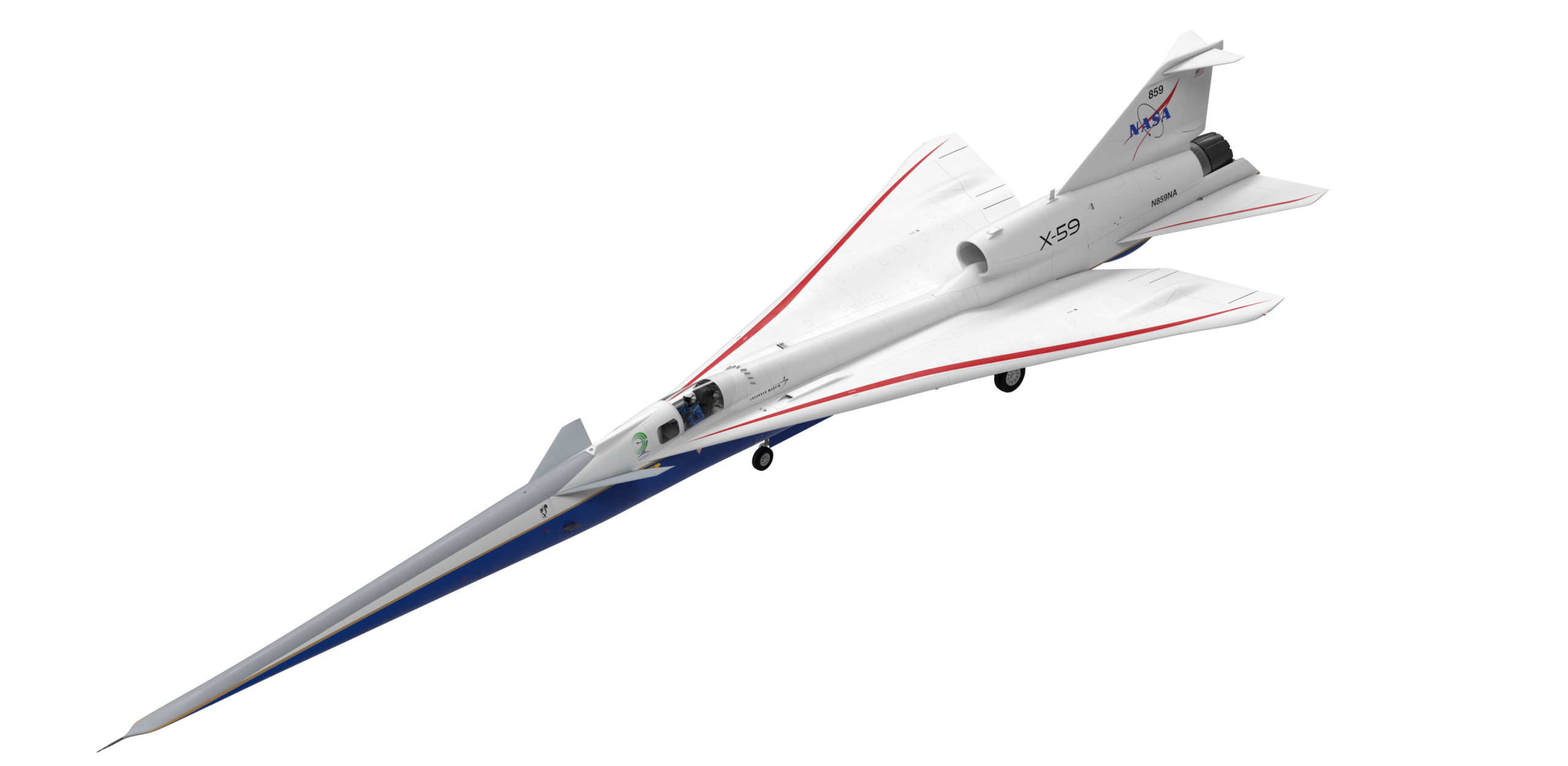
WASHINGTON / KENNEDY SPACE CENTER, November 1, 2026 — NASA’s experimental X-59 quiet supersonic aircraft is crossing the United States for the first time, heading from California to Florida as it enters a new phase of its flight-testing programme.
The journey began on October 28, 2026, exactly one year after the aircraft’s maiden flight. Developed by Lockheed Martin’s Skunk Works for NASA’s Quesst mission, the X-59 is designed to demonstrate that aircraft can travel faster than sound while producing a significantly quieter sonic signature than conventional supersonic jets.
The aircraft departed Edwards Air Force Base in California and travelled through El Paso and Fort Worth, Texas, before reaching Birmingham, Alabama, on its journey towards NASA’s Kennedy Space Center in Florida.
It is expected to appear at NASA’s MAX POWER aerospace expo and airshow on November 7–8.
One year of flight testing: Mach 1.53 achieved
NASA marked the first anniversary of the X-59’s maiden flight on October 28, confirming that the experimental aircraft had completed 40 additional flights since its first take-off in 2025.
During the testing programme, the aircraft reached a maximum speed of Mach 1.53, approximately 1,010 miles per hour, and an altitude exceeding 56,000 feet.
On June 5, 2026, the X-59 broke the sound barrier for the first time, reaching approximately Mach 1.1 at an altitude of 43,400 feet.
A week later, it demonstrated its intended mission operating conditions of Mach 1.4 at approximately 55,000 feet.
These milestones represent progress in expanding the aircraft’s flight envelope and preparing it for the next stage of NASA’s research.
How does the X-59 reduce the sonic boom?
Conventional supersonic aircraft generate shockwaves that combine into powerful sonic booms, which can be heard over large areas on the ground.
The X-59 has an unusually long, narrow nose and a specially shaped fuselage designed to control how these shockwaves form and travel.
Instead of producing a conventional explosive sonic boom, NASA expects the aircraft to generate a much softer sound known as a sonic thump.
At its intended operating conditions of Mach 1.4 and 55,000 feet, the target sound level is approximately 75 decibels on the perceived-level scale. NASA has compared the projected sound to a car door closing from about 20 feet away.
This is a design objective that must still be evaluated through dedicated acoustic testing.
Why does the aircraft have no conventional front windshield?
One of the X-59’s most unusual features is its cockpit configuration.
Because of its exceptionally long nose, the pilot does not have a conventional forward-facing windshield. Instead, the aircraft uses NASA’s eXternal Vision System, which combines cameras and cockpit displays to provide an external view.
The system allows the pilot to monitor the aircraft’s surroundings despite the unusual cockpit position and nose design.
Could this change the future of commercial supersonic travel?
The X-59 is part of NASA’s Quesst mission, which aims to collect scientific data about quieter supersonic flight and public reactions to its sound.
After the aircraft completes the required flight-envelope testing, NASA plans to conduct acoustic validation flights using specialised equipment on the ground and in the air to measure the sound produced by the aircraft.
The agency also plans to fly the X-59 over selected communities in the United States and collect feedback from residents about the sound they hear.
The findings will be shared with aviation regulators in the United States and internationally.
Commercial supersonic flight over land has faced restrictions in the United States since 1973, primarily because of the disruptive effects of sonic booms. NASA hopes that its research could provide regulators with evidence to consider future noise-based standards rather than relying solely on aircraft speed.
However, the X-59 itself is an experimental research aircraft, not a commercial passenger-airliner prototype. Its successful testing would not automatically lift existing restrictions or authorise commercial supersonic flights over land.
The research could nevertheless help shape the regulatory framework for a future generation of quieter, faster aircraft.
Sources & References
- NASA – Celebrates a Year of Progress Since First X-59 Flight, October 28, 2026
- NASA – X-59 Completes Record Six Flights in One Week, October 2, 2026
- NASA – X-59 Aircraft Flies Supersonic for First Time, June 5, 2026
- NASA – Quesst: The X-59 Research Aircraft
- NASA – Quesst and the 1973 Supersonic Flight Restrictions
- Aviation International News – X-59 Heads to Florida, October 30, 2026
- AVweb – NASA X-59 Begins Cross-Country Flight to Florida, October 29, 2026
THE WORLD’S UPDATE
Sabse sach, sabse pahle.
Leave a Reply