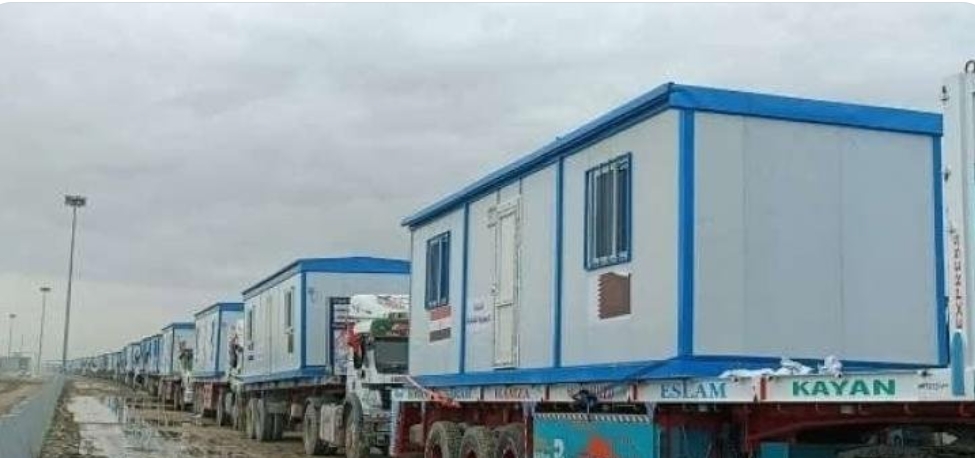
As displaced Palestinian families struggle in flooded tents, Israel continues to block mobile homes from entering Gaza. Meanwhile, caravans have been transported to settlement construction sites near Tayasir in the occupied West Bank. The contrast raises serious questions about Israel’s treatment of Palestinian civilians and its settlement policies.
The contradiction is difficult to ignore.
Palestinian families in Gaza are facing another winter without adequate shelter. Their tents are being flooded by heavy rain, their bedding and belongings are getting soaked, and many families have nowhere safe to go.
Yet mobile homes, which could provide better protection against rain, wind and cold, remain blocked from entering Gaza by Israeli authorities.
At the same time, mobile homes are being installed at Israeli settlement sites in the occupied West Bank.
These developments raise a fundamental question: Why are safer temporary homes being made available for settlement expansion while displaced Palestinian families in Gaza remain trapped in inadequate shelters?
1. Gaza: Palestinian Families Left in Flooded Tents
On November 8, heavy rainfall caused widespread flooding across Gaza.
According to the United Nations Office for the Coordination of Humanitarian Affairs (OCHA), humanitarian organisations received reports from more than 26,000 households whose shelters or belongings had been damaged.
The UN also reported that humanitarian stocks inside Gaza were almost exhausted.
The situation included:
- Around 70,000 tents affected by flooding, according to figures reported by humanitarian organisations.
- More than 6,000 family shelters reportedly destroyed.
- Around 17,400 shelters damaged.
- More than 3,900 households left without shelter.
At least five Palestinians, including three children, were killed when a sand embankment collapsed onto tents in Deir al-Balah.
The UN warned that worn-out tents and makeshift shelters offered little protection against severe weather.
These are not simply uncomfortable living conditions. They expose children, elderly people and other vulnerable civilians to serious risks.
2. Israel Continues to Block Mobile Homes From Gaza
Mobile homes and caravans can provide stronger protection against heavy rainfall and cold temperatures than ordinary tents.
Humanitarian organisations have repeatedly called for their entry into Gaza.
However, Israel continues to prohibit their entry.
In its November 9 report, The Times of Israel confirmed that mobile homes remained banned, despite humanitarian organisations considering them essential for winter protection.
The Israeli military says it is concerned that construction equipment and other materials could be used by Hamas to rebuild military capabilities.
But that security argument does not remove the humanitarian consequences of keeping essential shelter supplies out of Gaza.
The US-backed Board of Peace has also criticised the Israeli response, saying that the measures remain insufficient and calling for the immediate entry of winterisation supplies.
3. West Bank: Caravans Installed Near Tayasir
While mobile homes remain blocked from Gaza, developments are taking place near Tayasir in the northern West Bank.
In July 2026, Israeli forces brought more than 20 caravans to an area near the Tayasir military checkpoint, east of Tubas.
According to Palestinian official Mutaz Bisharat, the caravans were brought to the site of the Goder settlement project.
Arab News and the investigative outlet Misbar reported that land levelling and excavation were also taking place.
The project is linked to an Israeli government decision to establish new settlements in the occupied West Bank.
This is not an isolated example. Israeli settlement-monitoring organisation Peace Now reported in October that plans for two new settlements included mobile-home neighbourhoods.
The contrast is clear: caravans are being used as part of settlement development in the West Bank, while displaced Palestinian families in Gaza are still waiting for more durable shelter.
4. The Occupied West Bank and International Law
The settlement issue is not merely a political disagreement.
In its July 2024 advisory opinion, the International Court of Justice concluded that Israeli settlements in the occupied West Bank and East Jerusalem, and the associated regime, violate international law.
The Court also concluded that Israel’s continued presence in the Occupied Palestinian Territory is unlawful and that Israel must immediately cease all new settlement activity.
The opinion provides an important legal framework for examining settlement expansion and the treatment of Palestinians living under occupation.
5. Humanitarian Aid Must Reach Palestinians, Not Become a Publicity Exercise
The Israeli military has claimed that more than 91,000 tents and 8,200 trucks carrying winter supplies have entered Gaza.
It has also announced approvals for vaccines, mobile clinics and medical equipment.
But the entry of supplies, their distribution and the actual conditions of Palestinian families must be examined separately.
Photographs of cargo bearing UNICEF branding and other international humanitarian markings also raise an important question about attribution.
Humanitarian assistance provided by UNICEF, international organisations and donor countries should be credited to those organisations and contributors. It should not automatically be presented as an independent Israeli achievement.
The UN’s reports of severe shelter shortages and restrictions on essential equipment show that major humanitarian needs remain unresolved.
The Question Israel Must Answer
If mobile homes are suitable for protecting people against winter conditions and are being installed at settlement projects in the occupied West Bank, why are displaced Palestinian families in Gaza being denied access to this safer form of temporary shelter?
Why are Palestinian children expected to spend another winter in damaged and flooded tents while settlement infrastructure continues to expand elsewhere in occupied Palestinian territory?
The international community must look beyond official announcements and examine what is actually happening to Palestinian families.
Humanitarian protection should not depend on whether people are Palestinians living in Gaza or Israeli settlers living in the West Bank.
Every displaced civilian deserves safe shelter, protection and dignity.
Sources
- UN OCHA, Humanitarian Situation Report, 8 November 2026: https://www.ochaopt.org/content/humanitarian-situation-report-heavy-rains-gaza-strip-8-november-2026
- UN OCHA, Humanitarian Situation Report, 5 November 2026: https://www.ochaopt.org/content/humanitarian-situation-report-5-november-2026
- The Times of Israel, 9 November 2026: https://www.timesofisrael.com/board-of-peace-warns-israel-to-send-more-winter-aid-to-gaza-as-idf-says-supplies-delivered/
- Al Jazeera, 9 November 2026: https://www.aljazeera.com/amp/features/2026/11/9/tents-dont-protect-us-rains-flood-displaced-palestinians-gaza
- Arab News, 29 July 2026: https://www.arabnews.com/middle-east/activity-near-tayasir-checkpoint-fuels-fears-of-new-israeli-settlement-in-west-bank-2652644
- Misbar, 12 August 2026: https://www.misbar.com/en/editorial/2026/08/12/gate-northern-jordan-valley-misbar-tracks-two-settlement-projects-near-tayasir-checkpoint
- International Court of Justice – UN summary of the 2024 Advisory Opinion: https://www.un.org/unispal/document/summary-of-the-icj-order-icj-19jul24/
- Israeli military statement: https://x.com/CaptainElla1/status/2119823723964367176
- Tayasir mobile-home footage: https://x.com/WarGuy_/status/2120050253944517087
Standing with the oppressed. Speaking for the unheard. Seeking truth without fear.