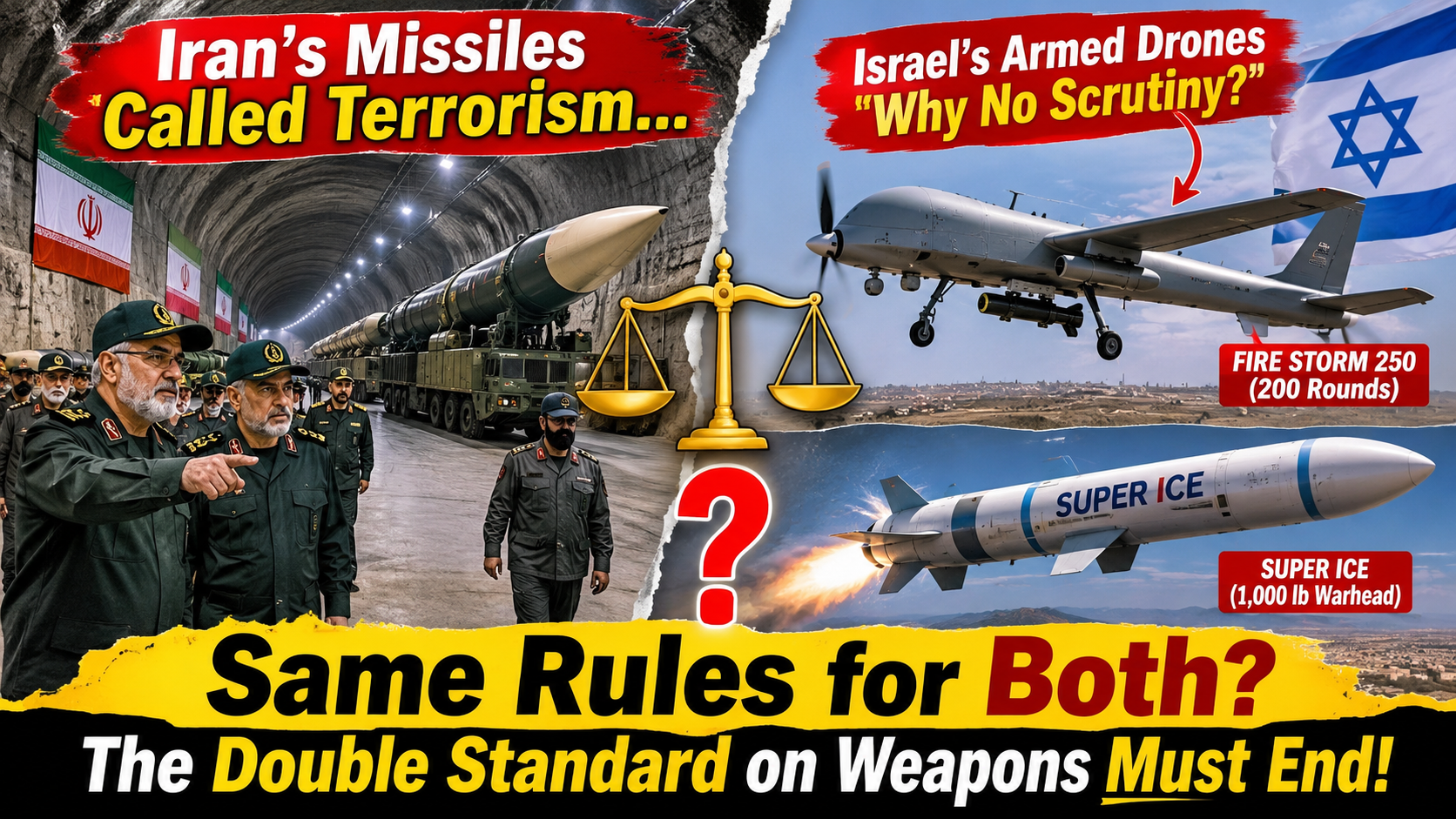
Israel’s Foreign Ministry has described Iran’s underground missile arsenal as a terrorist threat. But Israel is also developing increasingly powerful offensive weapons, including a cruise missile carrying a 1,000-pound warhead and an armed drone capable of carrying 200 rounds of machine-gun ammunition. The question is not which country owns the weapons. The question is how they are used, whom they target and whether the same standards apply to everyone.
Israel’s Foreign Ministry has accused Iran of displaying an underground terrorist arsenal after the Islamic Revolutionary Guard Corps (IRGC) released footage of what it described as a new underground “missile city”.
The facility reportedly contains ballistic missiles, cruise missiles and launch systems.
Iranian military commanders also issued threatening statements during the unveiling. Major General Ali Abdollahi reportedly said Iran would destroy Israel in response to remarks by Israeli Prime Minister Benjamin Netanyahu.
Such threats deserve serious scrutiny. Threats against civilian populations cannot be dismissed as ordinary political rhetoric.
But there is another question that deserves equal attention.
Why does Israel present Iran’s military weapons as evidence of a terrorist threat while its own offensive weapons programmes receive a different description?
Iran’s underground missile arsenal
On November 10, 2026, Iranian state-linked media released footage showing senior military commanders touring an underground missile facility.
The footage displayed ballistic and cruise missiles, launch equipment and military vehicles.
The Jerusalem Post reported that the facility’s status as a newly constructed site could not be independently verified.
Iran’s military leadership used the event to communicate that its missile capabilities had survived previous American and Israeli attacks.
Iranian military officials also warned of further retaliation if the country faced another attack.
These statements are serious. A country has the right to maintain defensive capabilities, but that right does not include an unrestricted licence to threaten civilians or conduct indiscriminate attacks.
Israel’s FIRE STORM 250: An armed drone carrying 200 rounds
Now consider Israel’s own weapons development.
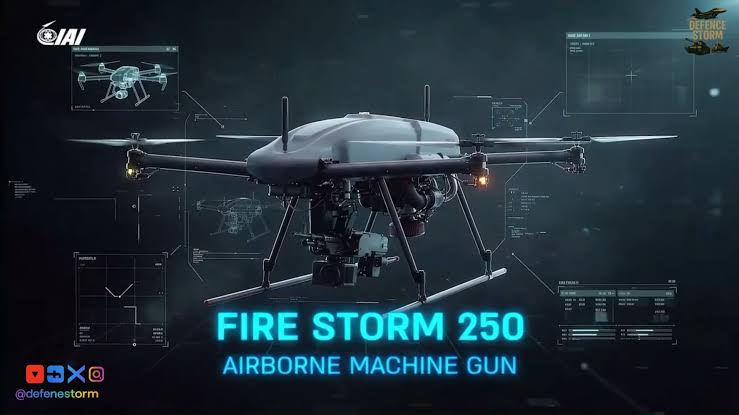
On October 13, 2026, Israel Aerospace Industries (IAI) and American weapons manufacturer SIG SAUER announced a successful live-fire test of the FIRE STORM 250.
The unmanned aircraft combines an IAI drone platform with a remotely operated weapon station carrying an M250 machine gun.
According to IAI:
- It can carry 200 rounds of ammunition.
- It can remain airborne for up to three hours.
- It can take off and land vertically.
- Its onboard camera helps identify targets.
- It demonstrated firing in single-shot and semi-automatic modes.
The companies describe it as a platform for surveillance, border security and tactical fire support.
The important question is how this system will be used in actual operations.
An armed drone does not become lawful simply because a human operator controls it. Its targets, firing decisions and consequences for civilians remain subject to international humanitarian law.
SUPER ICE: A cruise missile with a 1,000-pound warhead
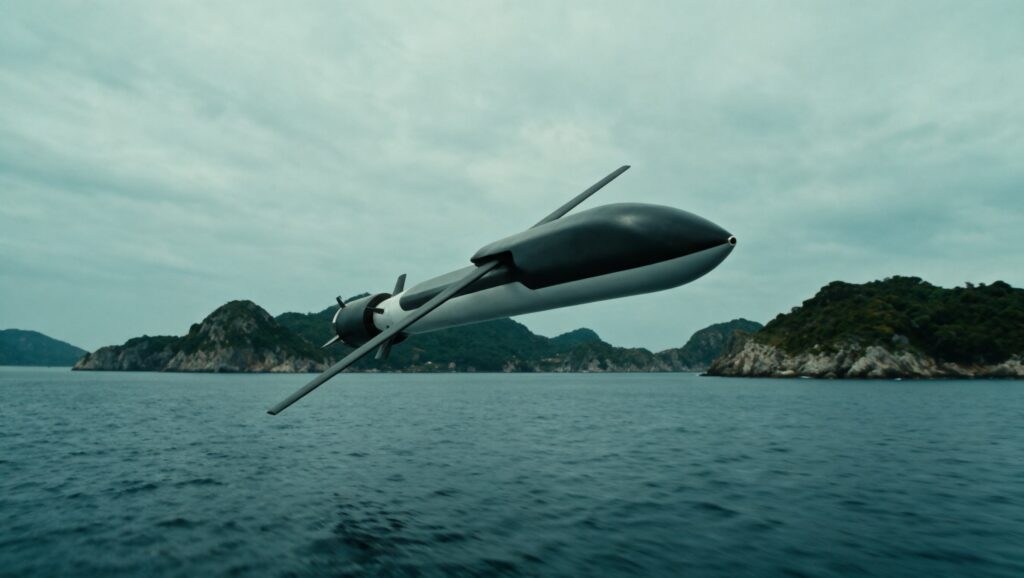
On November 11, Israeli defence company Rafael unveiled another weapon: SUPER ICE.
The company announced that the cruise missile can carry a 1,000-pound (454-kilogram) warhead compatible with the MK-83 bomb class.
It is designed for launch from air, land and sea platforms.
Rafael says the system includes autonomous navigation, low-altitude terrain-following flight, all-weather capability and image-matching technology.
The company describes it as a weapon for long-range attacks against high-value strategic targets, including air-defence systems.
This is a substantial offensive capability.
Yet the existence of such a weapon does not automatically prove an intention to attack civilians. The same standard must apply when examining Iran’s missile arsenal.
International humanitarian law must apply to both sides
The International Committee of the Red Cross identifies three central principles governing attacks during armed conflict:
1. Distinction: Parties must distinguish between civilians and combatants, and between civilian objects and military objectives.
2. Proportionality: An attack is prohibited if the expected civilian harm would be excessive compared with the anticipated concrete and direct military advantage.
3. Precautions: Parties must take all feasible precautions to avoid or minimise civilian casualties and damage to civilian objects.
These principles apply to missiles, aircraft, armed drones and other weapons.
The ICRC specifically explains that armed drones are not automatically prohibited under international humanitarian law. Their use must comply with the same rules governing other weapons.
Therefore, the question is not whether a weapon is Iranian or Israeli.
The question is whether its use complies with international law.
The double-standard question
If Iran’s military threats are considered dangerous, they should be examined.
If Iran develops weapons capable of striking civilian areas indiscriminately, that conduct must also face scrutiny.
But the same scrutiny must apply to Israel.
If an Iranian missile strikes civilians, it must be investigated.
If an Israeli missile strikes civilians, it must also be investigated.
If an Iranian armed drone is used unlawfully, accountability is required.
If an Israeli armed drone is used unlawfully, accountability is equally necessary.
No country should be allowed to turn its own weapons into symbols of national security while describing every weapon held by its adversary as terrorism.
The real question is accountability, not propaganda
The Iranian underground missile facility raises legitimate security concerns. Iranian commanders’ threatening statements should not be ignored.
But Israel cannot claim that military power is legitimate simply because it is presented as self-defence.
Nor can Iran claim that every military action is justified simply because it describes itself as resistance.
The protection of civilians cannot depend on political alliances, national identity or which government is speaking.
The same legal standards must apply to Tehran, Tel Aviv, Washington and every other government involved in armed conflict.
Weapons do not become lawful because their owners call them defensive. And weapons do not become terrorist weapons merely because they belong to an enemy. Their development, intended use and actual consequences must be examined under the same rules.
That is what equal accountability means.
THE WORLD’S UPDATE
Standing with the oppressed. Speaking for the unheard. Seeking truth without fear.
Sources & References
- Israel Foreign Ministry – Original statement accusing Iran of displaying an underground terrorist arsenal, November 11, 2026
- The Jerusalem Post – Iran unveils underground missile city, November 10, 2026
- Tasnim News Agency – Iranian General’s remarks at the missile-city unveiling, November 10, 2026
- Israel Aerospace Industries – FIRE STORM 250 live-fire test, October 13, 2026
- The Jerusalem Post – Israeli FIRE STORM 250 drone and its 200-round machine gun
- Rafael SUPER ICE missile announcement – Report by i24NEWS, November 11, 2026
- The Times of Israel – SUPER ICE and its 1,000-pound warhead
- International Committee of the Red Cross – International humanitarian law and armed drones
- International Committee of the Red Cross – Conduct of hostilities and protection of civilians