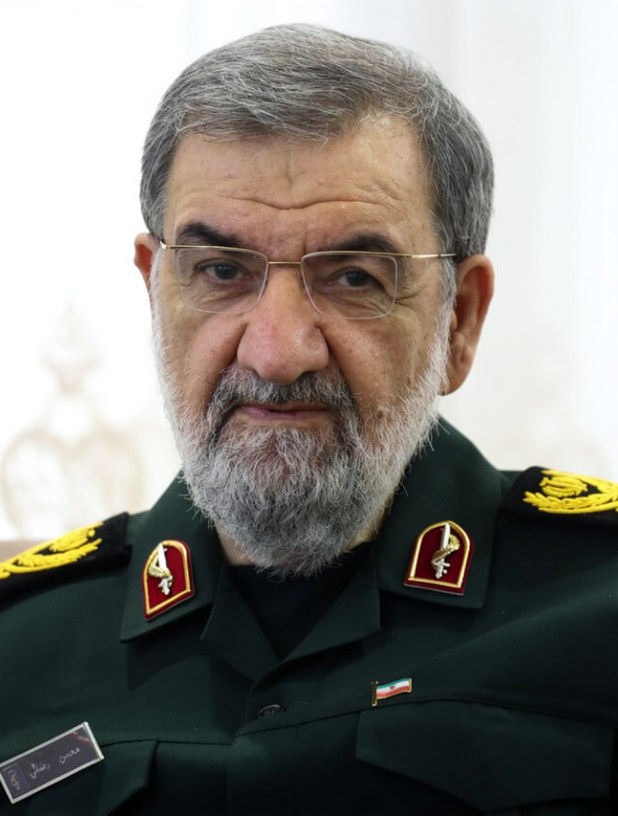
Iran’s Supreme National Security Council Secretary Mohsen Rezaei has claimed that US Defence Secretary Pete Hegseth could not keep pace with Iranian military commanders. He says Iran demonstrated superiority over the United States and Israel in managing the defensive battlefield. Independent assessments, however, present a more complex picture of the conflict.
Iran’s senior security official Mohsen Rezaei has claimed that Iran demonstrated superior defensive battlefield management during its confrontation with the United States and Israel.
In a statement shared by Clash Report, Rezaei criticised US Defence Secretary Pete Hegseth, describing him as inexperienced and saying he was unable to keep up with Iranian generals.
Rezaei said:
“We demonstrated our superiority over the United States and Israel in defense management, particularly in managing the defensive battlefield.”
These are Rezaei’s claims. They should not be treated as independently established military findings.
Who is Mohsen Rezaei?
Rezaei is a former commander-in-chief of Iran’s Islamic Revolutionary Guard Corps (IRGC). He led the organisation from 1981 to 1997, including during much of the Iran-Iraq War.
In August 2026, he was appointed secretary of Iran’s Supreme National Security Council, an institution responsible for coordinating the country’s national security and foreign policy.
His military background gives him extensive experience in Iran’s security establishment. However, his official position also means his statements should be understood in the context of Iran’s wartime messaging.
What does battlefield management mean?
Defensive battlefield management involves more than intercepting incoming missiles.
It can include:
- Coordinating air-defence systems and radar networks.
- Protecting military installations and critical infrastructure.
- Managing missile and drone threats.
- Preserving command structures and communication systems.
- Maintaining military operations under sustained attack.
- Managing ammunition and interceptor supplies.
A country may successfully defend some targets while suffering serious damage elsewhere. Therefore, claims of overall superiority require evidence across several military and operational measures.
What do independent assessments say?
The Carnegie Endowment for International Peace published a military assessment of the US-Israeli war with Iran in April 2026.
Its analysis described significant US and Israeli operational successes. These included damage to Iranian air and naval capabilities, air defences and parts of its missile and drone arsenal.
However, the assessment also noted that Iran retained the ability to launch attacks against Israel, US bases in the Gulf, regional infrastructure and commercial shipping.
It also highlighted the economic and military costs imposed by Iran, including the expenditure of expensive defensive and offensive munitions.
A separate analysis published by the Center for Strategic and International Studies (CSIS) in July 2026 said the US air-defence campaign had achieved high, although imperfect, interception rates. Some Iranian attacks nevertheless penetrated those defences, causing casualties and damage to military bases.
The CSIS assessment also warned that the expenditure of Patriot and THAAD interceptors had reduced available stockpiles.
These findings indicate that both sides achieved certain military objectives while facing significant limitations.
Was Iran actually superior to the United States and Israel?
That conclusion cannot be established from Rezaei’s statement alone.
Iran’s ability to continue launching missiles and drones, maintain its command structure and impose costs on its adversaries is relevant to assessing its defensive performance.
At the same time, damage to Iranian military infrastructure, air-defence systems and other capabilities must also be considered.
A complete assessment would require reliable information about interception rates, military losses, infrastructure damage, operational readiness and the ability of each side to sustain its operations.
Some of that information remains disputed or unavailable for independent verification.
The difference between political claims and military evidence
During an armed conflict, political and military officials have incentives to present events as victories.
Iranian officials may emphasise the survival of the country’s military capabilities and its ability to retaliate. US and Israeli officials may highlight the damage inflicted on Iranian military infrastructure and the effectiveness of their operations.
Neither side’s public statements should replace independent assessment.
Rezaei’s remarks reveal how Iran’s leadership wants the defensive performance of its armed forces to be understood. Whether that performance amounted to overall superiority is a separate question that requires verifiable evidence.
The real measure of military performance is not the confidence of a statement or the strength of a political speech. It is what the evidence shows about capabilities, losses, operational results and the ability to sustain a conflict.
THE WORLD’S UPDATE
Standing with the oppressed. Speaking for the unheard. Seeking truth without fear.
Sources & References
- Clash Report – Mohsen Rezaei’s statement on Hegseth and Iran’s defensive battlefield management
- Reuters – Who is Iran’s Mohsen Rezaei, the hardliner appointed to a key security role?
- Radio Free Europe/Radio Liberty – From Punchline to Power: The Rise of Iran’s Security Chief Mohsen Rezaei, November 10, 2026
- Carnegie Endowment – A Military Balance Sheet in the U.S. and Israeli War With Iran, April 2026
- CSIS – Renewed Iran War Would Test Diminished Interceptor Inventories, July 27, 2026