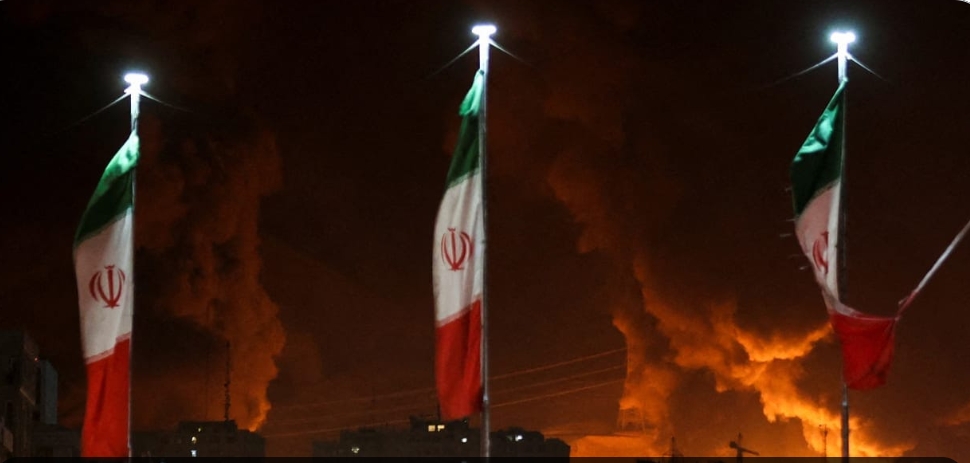
An Israeli strategic proposal to establish Iranian-led opposition enclaves inside Iran raises a fundamental question: if the Iranian people are supposed to decide their country’s future, why are foreign powers discussing how to construct an alternative authority on Iranian territory?
An increasingly significant debate is emerging in Israeli strategic circles about the future of Iran.
One proposal argues that Israel should work towards establishing a durable, Iranian-led enclave with functioning institutions before US President Donald Trump leaves office.
The language sounds like a plan for political transition. But the details raise much deeper questions about sovereignty, foreign intervention and the future territorial integrity of Iran.
A report published by the Middle East Forum, titled Fracturing the Iranian Regime, goes further. It proposes protected opposition enclaves inside Iran where alternative political institutions could organise, govern and demonstrate an alternative source of authority.
The report also discusses complementary roles for Washington and Israel: the United States would lead political, economic and transition-planning efforts, while Israel would continue military and intelligence pressure against the Iranian government’s coercive capabilities.
This is not simply a discussion about supporting democratic reform. It is a proposal for building an alternative political structure inside another sovereign country.
Who decides Iran’s future?
Iran’s political system faces serious criticism, including over political repression, restrictions on civil liberties and the treatment of protesters.
Those issues deserve scrutiny. The Iranian people have the right to demand political reform, accountability, freedom and representative institutions.
But that right belongs to Iranians.
It does not belong to the Israeli government, the American administration or any foreign intelligence agency.
There is a fundamental difference between supporting the Iranian people’s right to choose their government and designing political structures inside Iran with assistance from foreign powers.
A government can be unpopular. Its policies can be challenged. Its leaders can be held accountable.
None of that gives another country an automatic right to decide how Iran should be governed.
The proposal raises questions about Iran’s territorial integrity
The word “enclave” deserves particular attention.
An enclave with its own functioning institutions, protected opposition leadership and external support could become an alternative centre of political and territorial authority.
Its supporters may describe it as a temporary arrangement for democratic transition.
But several questions remain unanswered:
- Who would control the territory?
- Who would provide security and enforce its authority?
- Would its institutions be accountable to Iranian voters?
- What would happen if local communities rejected the project?
- Could it survive without continuing foreign military, intelligence or financial support?
Without credible answers, a project presented as political transition could deepen fragmentation and create another long-term conflict.
The United Nations General Assembly’s Resolution 36/103, adopted in 1981, sets out principles against intervention in the internal affairs of states. It specifically addresses support for rebellious or secessionist activities and actions intended to undermine another country’s political order.
The principle is clear: political change inside a country should not become an excuse for external interference in its sovereignty.
Even Israeli strategic analysts acknowledge the limits of regime change
There is another important fact.
An analysis published by Israel’s Institute for National Security Studies on November 3, 2026, argued that regime change in Iran cannot simply be assumed to be inevitable.
The analysis noted that military pressure and economic crisis do not automatically produce political collapse. It also highlighted the continued cohesion of Iran’s security institutions, divisions among opposition groups and the absence of an agreed alternative leadership.
Its central assessment was that political change depends first and foremost on Iranian citizens and the internal balance of power.
This is an important admission from within Israel’s own strategic debate: weakening a government militarily is not the same as creating a legitimate replacement.
Military pressure does not automatically create democracy
The experience of Iraq and Libya offers important warnings.
The removal of a government does not automatically produce stable institutions, political reconciliation or public security.
Both countries experienced prolonged instability, armed competition and difficult political transitions after foreign military intervention.
Iran is not identical to either country. Its population, institutions, geography and political history are different.
But the broader lesson remains relevant: destroying an existing political structure is not the same as building a legitimate and functioning replacement.
A foreign-backed enclave could create more questions than it answers, particularly if its authority depends on external protection rather than public consent.
Iran’s future cannot be decided in Washington or Tel Aviv
The Iranian government must be accountable to its people. Human rights violations should not be excused simply because a country faces foreign pressure.
But the same principle must apply to foreign governments.
If Israel argues that Iranian citizens deserve freedom and political choice, that principle must include their freedom to reject a political project designed outside their country.
If Washington supports democracy, it should not confuse a foreign-backed political structure with democratic legitimacy.
And if the objective is regional stability, creating competing centres of authority inside Iran could carry consequences far beyond the country’s borders.
The question is not whether Iran needs political change. The question is who has the right to decide that change and how it should happen.
Iran belongs to its people. Its political future must be determined by Iranians—not engineered as a strategic project by foreign governments.
THE WORLD’S UPDATE
Standing with the oppressed. Speaking for the unheard. Seeking truth without fear.