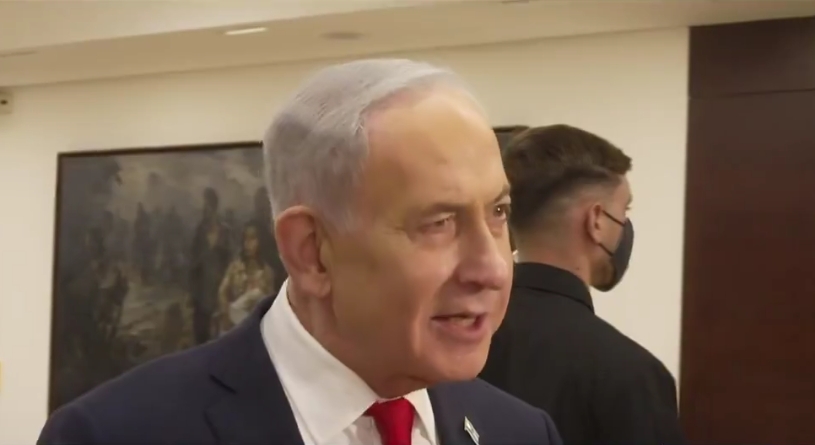
Israeli Prime Minister Benjamin Netanyahu has renewed his appeal for a national unity government, saying the country can come together during moments of national crisis. However, his proposal comes amid difficult coalition negotiations, after his political bloc lost its parliamentary majority and rival leader Gadi Eisenkot received the mandate to form the next government.
Netanyahu says unity is both necessary and possible
On November 11, 2026, Netanyahu spoke to reporters at the Knesset and repeated his call for a national unity government.
He argued that Israel had demonstrated its ability to unite during difficult moments, including the country’s recent war period.
Netanyahu said:
“A national unity government is necessary. It is possible because this country knows how to come together when it’s put to the test, what this moment calls for.”
He also said he would continue reaching out to political parties in an effort to bring them into a common government.
His message followed an earlier appeal for unity during the opening of the newly sworn-in 26th Knesset.
The political situation behind the appeal
Netanyahu’s call comes after the October 27 parliamentary election left his Likud-led bloc short of a majority.
The distribution of the 120 Knesset seats is:
- Netanyahu’s bloc: 53 seats.
- Gadi Eisenkot’s four-party political bloc: 48 seats.
- Arab-led parties: 19 seats.
A government needs the support of at least 61 lawmakers to secure a parliamentary majority.
President Isaac Herzog gave Eisenkot the mandate to form the next government after consultations with political parties. Eisenkot received recommendations from 67 lawmakers.
He has until December 6 to form a government, with a possible extension until December 20.
A disagreement over who should be included
Although Netanyahu is calling for unity, the political disagreement concerns which parties should participate.
He has advocated a coalition involving Likud, its existing right-wing allies, ultra-Orthodox parties and other Zionist parties.
He has also rejected a government that depends on support from Ra’am and the Joint List, the two Arab-led parliamentary parties.
Netanyahu has accused these parties of supporting terrorism and opposing Israel’s existence as a Jewish state. These are his political allegations, not independently established facts.
Eisenkot, meanwhile, is attempting to build a coalition around a different parliamentary arrangement.
The disagreement over Arab-party support, military service exemptions for ultra-Orthodox communities and the future political leadership remains a major obstacle to coalition negotiations.
What happens next?
Eisenkot faces the challenge of bringing together parties with different political priorities.
Netanyahu, despite leading the largest individual party, does not currently have the parliamentary numbers required to form a majority government through his existing bloc.
The coming weeks will determine whether Eisenkot can assemble a coalition, whether Netanyahu’s proposed unity arrangement gains support, or whether Israel faces another round of political uncertainty.
The central question: Unity under whose leadership?
Netanyahu’s appeal presents national unity as a response to Israel’s security and political challenges.
However, the negotiations show that the dispute is not simply about whether political parties should unite. It is also about who should lead the government, which parties should be included and what compromises they are prepared to accept.
His latest statement expresses a willingness to reach out to rivals. Whether that appeal produces an agreement will depend on the positions of the other parliamentary parties.
THE WORLD’S UPDATE
Standing with the oppressed. Speaking for the unheard. Seeking truth without fear.
Sources & References
- i24NEWS — Netanyahu says a national unity government is necessary and possible, November 11, 2026: https://x.com/i24NEWS_EN/status/2120514202607514113
- The Times of Israel — Day after Knesset speech, Netanyahu says unity is possible, November 11, 2026: https://www.timesofisrael.com/liveblog_entry/day-after-furious-knesset-speech-netanyahu-says-unity-is-possible/
- Reuters — Israel’s parliament sworn in as Eisenkot tries to forge a government, November 10, 2026: https://www.reuters.com/world/israels-parliament-sworn-eisenkot-tries-forge-government-2026-11-10/
- Anadolu Agency — Netanyahu insists he should lead Israeli unity government although Eisenkot got mandate, November 9, 2026: https://www.aa.com.tr/en/middle-east/netanyahu-insists-he-should-lead-israeli-unity-government-although-eisenkot-got-mandate/4117958