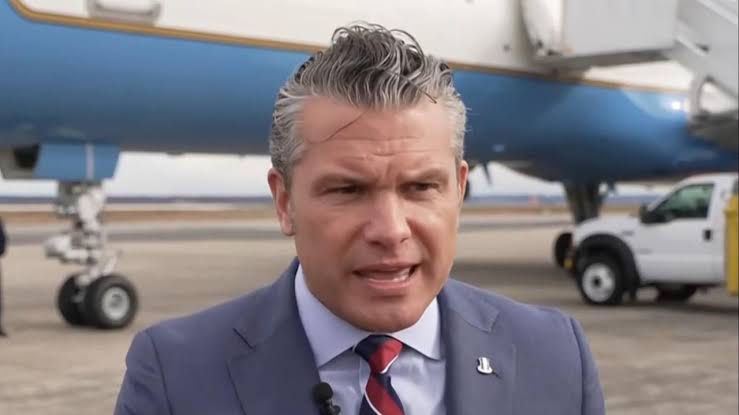
US Secretary of War Pete Hegseth has repeatedly defended President Donald Trump’s military decisions against Iran, describing the Iranian leadership as “crazy Islamists” and arguing that the United States cannot allow them to obtain nuclear weapons.
But Hegseth’s own published record raises a broader question: Is his hostility limited to Iran’s political leadership and armed extremist organisations, or does his rhetoric extend to Islam and Muslim communities more generally?
His 2020 book, American Crusade: Our Fight to Stay Free, contains statements about Islam, Muslim birth rates and immigration that have drawn criticism from journalists, civil rights advocates and commentators.
These are not allegations based merely on his religious identity or appearance. They are questions arising from his own published words.
1. Hegseth’s Statements About Islam
In American Crusade, Hegseth wrote that Islam “is not a religion of peace, and it never has been”.
That statement does not distinguish between extremist organisations and the millions of ordinary Muslims who practise Islam around the world.
A detailed review of his book by The Washington Post reported that Hegseth also described Islam as having been almost entirely captured and used by Islamists.
The book made an additional claim that Islamists account for 25 per cent of the global Muslim population and seek to force the rest of the world to submit or be killed. The newspaper described that figure as unsubstantiated.
The central concern is that Hegseth’s argument moves beyond criticism of violent organisations. It associates the religion itself, Muslim population growth and Muslim immigration with a wider threat to Western civilisation.
2. Muslim Birth Rates and Immigration Described as a Threat
Hegseth’s book also discusses Muslim birth rates and migration into Western countries.
According to The Washington Post’s examination, he argued that Islamists intended to transform Europe and America demographically, culturally and politically.
He described Muslim migration and population growth as part of an alleged strategy to change Western societies.
This language is significant because ordinary Muslim families, immigrants and children are not responsible for the actions of terrorist organisations or the political programmes of extremist movements.
Criticism of terrorism does not justify treating an entire religious population as a demographic or civilisational threat.
Hegseth’s own writing therefore provides substantial grounds for questioning whether his rhetoric crosses the boundary between opposing extremism and stigmatising Muslims.
3. The ‘American Crusade’ and Medieval Religious Warfare
The title of Hegseth’s book is itself relevant to understanding his political language.
In American Crusade, he draws comparisons between the present-day struggle against Islamism and the medieval Christian Crusades.
He writes that the current period resembles the 11th century and invokes the example of Christians who fought during that historical period.
The Crusades were a series of military campaigns associated with Christian efforts to capture or regain control of territories in the eastern Mediterranean, including Jerusalem. They involved extensive violence against Muslims and other populations.
Using this history as a model for a contemporary struggle against Islamism raises legitimate questions about the religious and civilisational framing of Hegseth’s political worldview.
The concern is not that every Christian symbol represents extremism. It is that Hegseth’s own writing combines Crusader imagery with sweeping claims about Islam and Muslim communities.
4. His ‘Deus Vult’ Tattoo and the National Guard Controversy
Hegseth has a Jerusalem Cross tattoo on his chest and the Latin phrase “Deus Vult” on his arm. The phrase means “God wills it” and is historically associated with the First Crusade.
In January 2021, a member of the Washington, DC, National Guard raised concerns about Hegseth’s “Deus Vult” tattoo, describing it as associated with supremacist groups and potentially relevant to an insider-threat assessment.
Hegseth has maintained that his tattoos express his Christian faith and has said he was removed from inauguration security duty because of a Christian symbol.
However, Associated Press reporting identified the “Deus Vult” tattoo as the specific symbol that prompted the concern.
The phrase has historical religious significance, but it has also been adopted by some contemporary far-right and white supremacist groups. Its use alone does not prove that Hegseth belongs to such groups or shares their ideology.
The controversy is relevant because of the wider context of his published comparisons between modern political conflict and the Crusades.
5. Hegseth’s Support for Controversial Military Pardons
Hegseth’s record also includes his campaign for presidential intervention in military justice cases involving American service members.
In 2019, while working as a Fox News host, he advocated for clemency for Navy SEAL Edward Gallagher, Army Lieutenant Clint Lorance and Army Major Mathew Golsteyn.
According to The Washington Post’s investigation, Hegseth discussed the cases with President Trump and portrayed the service members as warriors facing unfair treatment.
The legal outcomes were different:
- Edward Gallagher: Acquitted of murder charges involving a wounded Islamic State prisoner but convicted of posing for a photograph with the dead detainee. Trump later restored his rank.
- Clint Lorance: Convicted of ordering his soldiers to fire on Afghan men, resulting in two deaths. Trump granted him a full pardon.
- Mathew Golsteyn: Faced a murder trial over the killing of an Afghan detainee. Trump pardoned him before the trial.
The White House confirmed the clemency decisions in its November 15, 2019 announcement.
Hegseth and supporters of the pardons argued that American troops had been treated unfairly and needed greater freedom to make decisions in combat.
Critics, including military accountability advocates, warned that presidential intervention could weaken military justice and accountability.
These cases do not establish hostility towards Muslims by themselves. However, they are relevant to examining Hegseth’s approach to military power, civilian protection and accountability.
6. His Latest Remarks on Iran
On November 9, 2026, Hegseth defended Trump’s military decisions concerning Iran.
“You can’t let crazy Islamists have a nuclear bomb,” he said in a statement reported by Clash Report.
In a separate statement, he argued that criticism of Trump’s military operations also amounted to criticism of the American troops who carried them out.
He praised Trump’s decisions and the courage of American service members, while accusing Democrats of playing partisan political games.
“I couldn’t be more proud of what our president has done, the decisions that he’s made, the courageous calls that he’s made,” Hegseth said.
The statements were also reported by Fox News.
The United States has legitimate grounds to debate Iran’s nuclear programme, regional policies and military activities. But those questions should be examined through evidence and policy, not through language that risks portraying an entire religious community as an enemy.
7. Hegseth’s Defence: He Says His Target Is Radical Islamism
Hegseth and his supporters reject the accusation that he is hostile towards Muslims as a whole.
Their position is that his criticism is directed at radical Islamist movements, terrorism and political ideologies they consider threats to Western countries.
His Christian faith and tattoos, they argue, are personal religious expressions rather than evidence of hatred.
That defence must be acknowledged. Criticising Iran’s government, terrorist organisations or extremist political movements is not automatically anti-Muslim.
However, it does not answer the questions raised by Hegseth’s own book.
If his opposition is exclusively directed at violent extremists, why does his writing describe Islam itself as a religion that has never been peaceful? Why does it portray Muslim birth rates and migration as elements of a threat to Western civilisation?
Those are questions about his actual published statements, not assumptions about his private beliefs.
Conclusion: Where Does Criticism of Extremism End and Hostility Towards Muslims Begin?
Pete Hegseth is entitled to criticise Iran’s government, oppose nuclear proliferation and condemn terrorist organisations.
But holding a senior position in the American military establishment also brings responsibility for the language used to describe other societies and religious communities.
His published statements about Islam, Muslim immigration and birth rates go beyond a narrow discussion of terrorism. They provide substantial grounds for describing parts of his public rhetoric as anti-Muslim and Islamophobic.
The distinction matters: Muslims around the world cannot be held responsible for the actions of the Iranian government, armed organisations or individual extremists.
The question is not whether Hegseth is Christian, whether he served in Iraq, or whether he opposes Iran. The question is whether his own words demonstrate a consistent distinction between violent extremism and ordinary Muslims.
That question deserves public scrutiny.
Original statements:
Standing with the oppressed. Speaking for the unheard. Seeking truth without fear.