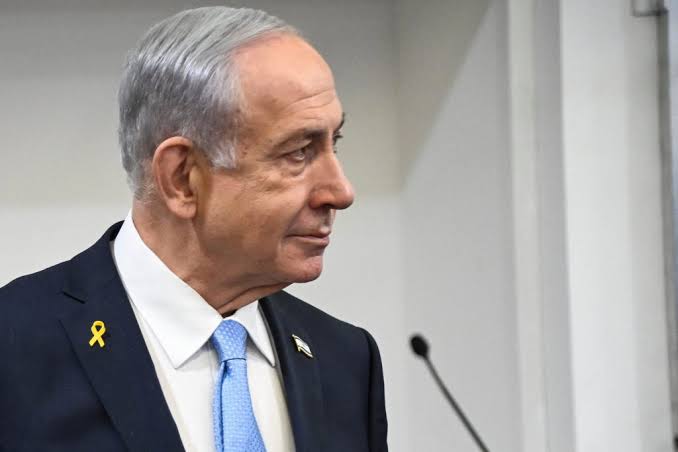
Israeli Prime Minister Benjamin Netanyahu has accused Arab political parties of supporting Hamas and radical Islam. He has also called for a national unity government, arguing that Israel cannot confront Iran and its regional allies while depending on political groups he describes as supporters of terrorism.
In a statement published on November 7, Netanyahu said that a government relying on Hamas supporters would be unable to fight Hamas. He also questioned how such a government could confront Iran and its regional allies.
His remarks come amid political uncertainty following Israel’s October 27 election. Netanyahu’s coalition has failed to secure a parliamentary majority, while opposition leader Gadi Eisenkot is seeking support to form the next government.
The controversy now centres on the role of Arab political parties in Israel’s parliament and Netanyahu’s attempt to exclude them from the proposed governing arrangement.
Netanyahu links Arab political parties to Hamas
In his statement, Netanyahu said:
“You cannot form a government with Hamas supporters.
You cannot fight Iran and its proxies if you depend on supporters of radical Islam inside the government.”
He then called for an end to political boycotts and urged rival parties to unite.
Netanyahu said the country needed to bring political forces together to confront the major challenges facing Israel. He added that he would discuss the proposal and work towards forming a unity government.
The full statement was shared by Clash Report on X.
However, Netanyahu’s description of Arab political parties as Hamas supporters is a political allegation. It should not be treated as independently established evidence that these parties support Hamas.
Israel’s election results created a coalition crisis
Netanyahu’s remarks come after Israel’s October 27 parliamentary election produced no clear majority.
His Likud-led coalition secured 53 seats in the 120-member Knesset. Meanwhile, the opposition bloc led by Gadi Eisenkot secured 48 seats.
Two Arab-led political groups, Ra’am and the Joint List, hold another 19 seats.
These numbers have made Arab political representatives particularly important in negotiations over the next government.
According to The Times of Israel, the Arab parties recommended Eisenkot to form the next government alongside other opposition factions.
The combined recommendations gave Eisenkot support from lawmakers representing 67 seats.
This political arithmetic explains why Netanyahu has focused so heavily on the Arab parties’ role.
Netanyahu demands unity but rejects an Arab-backed government
Netanyahu has presented a national unity government as the solution to Israel’s political crisis.
However, his proposal is not simply a call for every political faction to work together.
He has called for a government involving parties from the national camp and Zionist political bloc. At the same time, he has criticised the possibility of an opposition government relying on Arab parties.
According to The Jerusalem Post, Netanyahu warned that a government dependent on Islamist parties would threaten Israel’s security and its political identity.
This creates an important political contradiction.
Netanyahu is asking rival political forces to unite, but his proposed unity arrangement comes with clear political exclusions.
Arab representatives are part of Israel’s elected parliament
The Arab parties involved in the negotiations are political groups represented in Israel’s Knesset.
Their parliamentary participation is part of Israel’s electoral and political system. Their support for an opposition leader does not, by itself, establish that they support Hamas.
The distinction matters.
Political cooperation, parliamentary recommendations and support for a particular candidate are not automatically evidence of support for an armed organisation.
The Associated Press has reported that Arab lawmakers are considering ways to help replace Netanyahu, including supporting or abstaining in favour of an opposition government without necessarily joining it.
This is a political strategy to influence the formation of Israel’s next government. It should not be confused with proof of support for Hamas.
Netanyahu brings Iran and regional security into the debate
Netanyahu has also connected the coalition dispute to Israel’s confrontation with Iran and its regional allies.
He argues that a government dependent on parties he describes as supporters of radical Islam would be unable to address these security challenges.
However, the debate is not limited to foreign policy.
It also concerns who can participate in governing Israel, whose parliamentary support is considered legitimate and whether Arab representatives can influence the formation of a government.
By presenting their political support as a security threat, Netanyahu has moved the coalition debate beyond ordinary parliamentary negotiations.
The central question behind Netanyahu’s unity appeal
Netanyahu is calling for unity at a time when his own political bloc lacks a parliamentary majority.
His remarks place Arab political representatives at the centre of the controversy and portray their potential support for an opposition government as a danger to Israel.
Yet the available election results establish a political reality: Arab parties hold parliamentary seats, and their recommendations have become important in the effort to form a government.
Their political role should be examined through their public statements, policies and parliamentary actions, rather than through unproven allegations.
The question is therefore not simply whether Israel needs a unity government. It is whether Netanyahu’s demand for unity includes political cooperation across Israel’s elected parliament or only cooperation among parties that share his preferred political identity.
Standing with the oppressed. Speaking for the unheard. Seeking truth without fear.